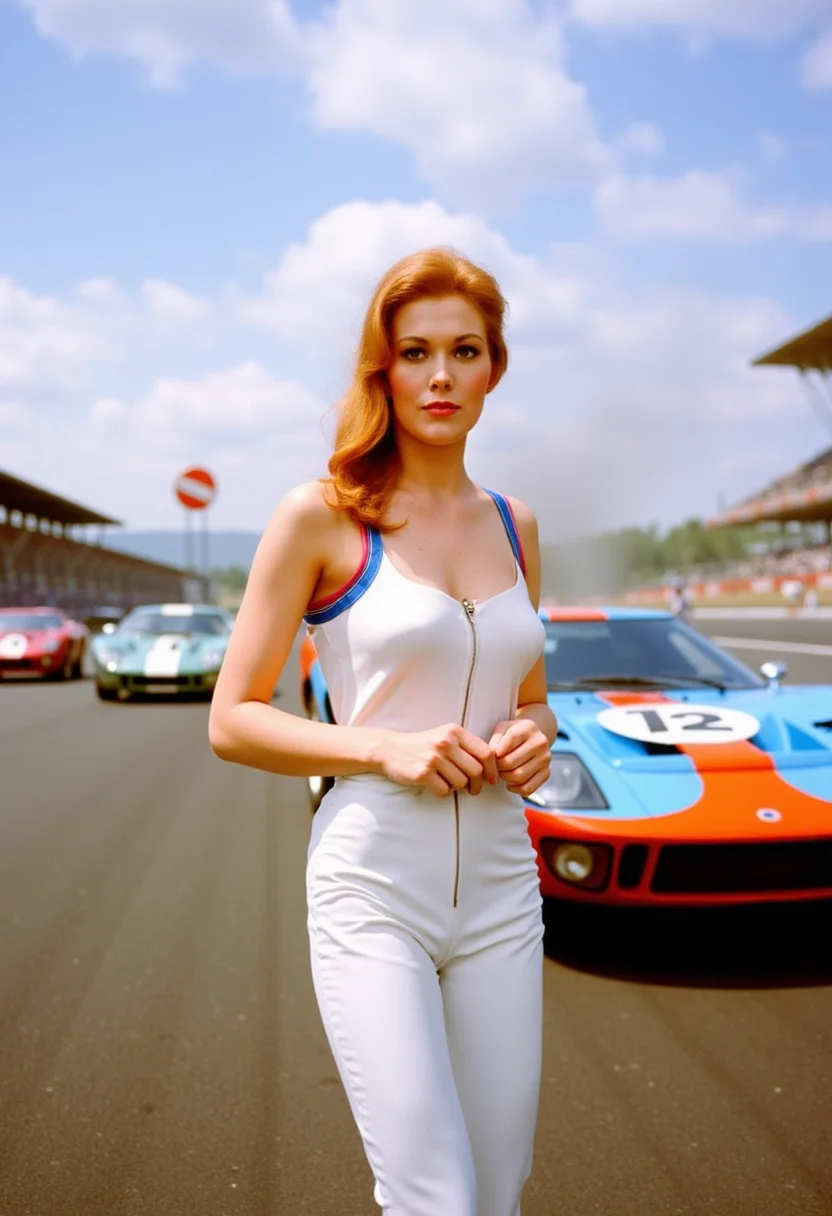
“Racing Queen, 1960s Inspired, Le Mans” Setting & Mood It’s the summer of 1966, the Le Mans race just past its peak. The track is alive with the energy of the roaring cars and the pounding heat of the sun. The bright powder-blue Ford GT40, adorned with its signature orange racing stripes, is parked in the background, smoke billowing from its overheating engine. The atmosphere is thick with the smell of gasoline, rubber, and sweat—an electric mix of triumph and defeat. Kim Novak, stepping off the track, has just witnessed the chaos of the race. She is the definition of grit and grace—her emotions as raw as the bruises on her skin. Her racing suit, open at the neck, reveals the hint of cleavage and sweat that glistens on her skin, a testimony to her time under the unforgiving sun. The saturated colors of the scene evoke the vibrant, electric atmosphere of an Elvis Presley movie, with warm oranges and vivid blues mixing to create a cinematic feeling of tension and beauty. Kim Novak: Look & Attitude Her long sleek straight face framing orange hair with low blunt bangs over the eyes, is the epitome of 1960s effortless cool. The hair is neatly tucked behind her ears, no curls—just straight, a little tousled from the heat and adrenaline. Her expression is one of anger and determination, a glance over her shoulder as she walks away from the chaos, unflinching. There’s a hint of bruising on her lip and cheek, a sign of the harshness of the race—an unexpected clash of beauty and toughness. Her body moves with purpose—strong and athletic, yet undeniably feminine, a perfect blend of youth and experience. The tight-fitting racing suit is zipped halfway down her chest, revealing a small hint of cleavage, while the damp fabric clings to her skin, a reflection of the long hours spent under pressure. The suit, white with blue and red accents, is marked with the logo of her sponsor—but all eyes are on her, the Racing Queen who doesn’t need to prove herself to anyone. Photographer & Concept • Photographer: David Bailey, inspired by the mid-1960s glamour and rock ‘n roll ethos, known for capturing raw moments of beauty and rebellion. • Concept: “The Racing Queen of Le Mans”—the moment after the race, where emotions run high, and the line between beauty and battle blurs. • Stylistic Influence: A blend of 1960s glamour and racing grit, where fashion and athleticism meet, inspired by the dynamic energy of racing legends and pop culture icons. Lighting & Depth of Field • Lighting: The golden light of the afternoon sun spills over the scene, casting long shadows and illuminating the dust and sweat on her skin. The light plays off the car’s metallic body and her wet skin, enhancing the raw, sun-soaked atmosphere of the track. • Depth of Field: Kim is sharply in focus, the background just slightly blurred—allowing her to stand out as the central figure in this world of chaos and speed. • Angle: A medium close-up, taken from a low angle, capturing her from the waist up as she strides confidently away from the burning GT40. The angle adds a sense of dominance and power, while also framing the moment of intense emotion and rebellion. Intrigue & Narrative As she walks off the track, the rumble of engines fades into the background. The Ford GT40, a symbol of victory and defeat, continues to burn in the distance, while Kim’s face tells the story of a woman in control, yet caught between her own struggle and the chaos of the race. The bruises on her face are marks of her resilience, while the sleek, wet fabric of her suit is an elegant testament to her femininity amidst the harsh world of racing. Her eyes reflect the weight of the race—disappointment, but also the knowledge that she has survived it. She might have lost the battle, but this isn’t the end. As the camera catches her final stride, her expression says it all—she’s not done yet.
Parameters used to generate this content
AI models used to generate this content