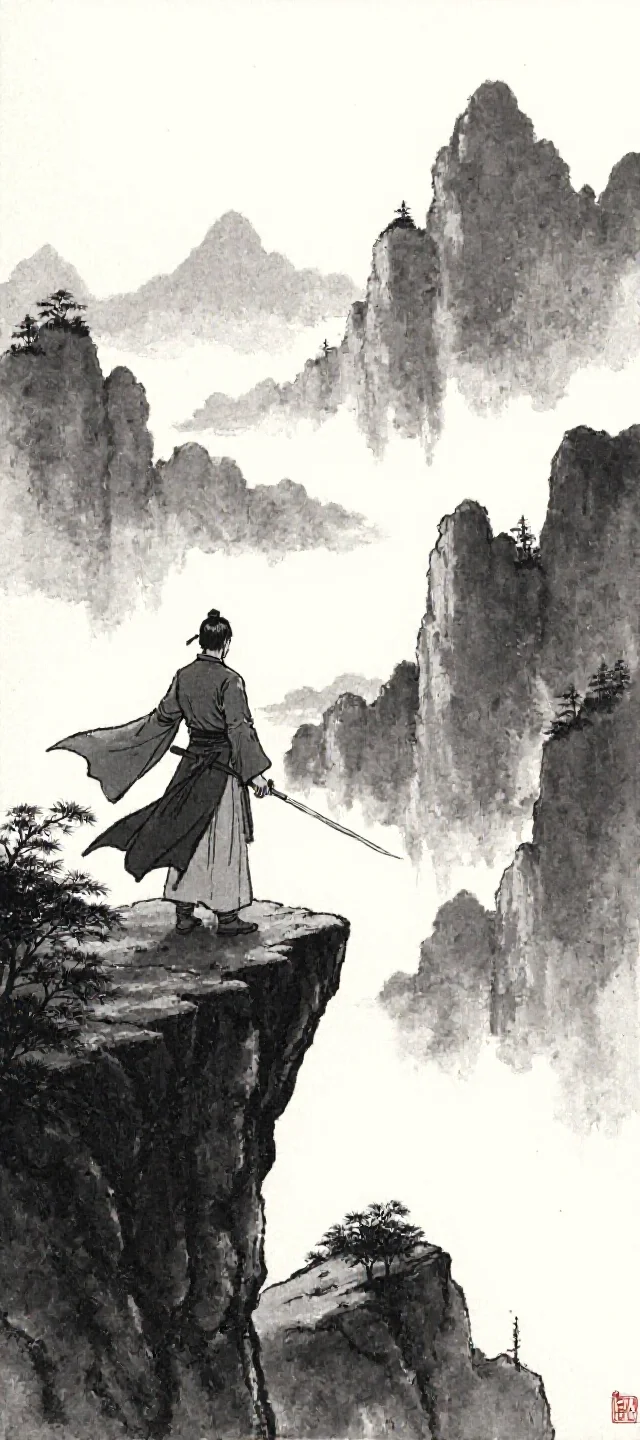
Traditional Chinese ink wash painting style, Xieyi (expressive and spontaneous), unrestrained brushwork, dripping with ink, vivid spiritual resonance (Qiyun). Amidst cold mountains and valleys, the background is rendered with broad strokes of light ink and water washes, depicting distant mountains and pervading mist, blending the real and the ethereal for a profound artistic mood. At the visual center of the frame, the back or side profile of a swordsman stands on the edge of a cliff. His figure is sketched with a few powerful and vigorous lines, simple yet precise. He wears a wide robe, its sleeves moving with the wind. The ink tones vary in concentration and wetness, creating a strong sense of movement. He holds his sword in one hand, its tip pointing naturally downwards. The composition utilizes a great deal of negative space (Liubai), especially in the treatment of the sky and mist, to create a sense of the vastness of heaven and earth and the smallness of man. Shadows are not depicted realistically but are integrated into the "Cunfa" (texture strokes) of the rocks and the folds of the clothing, using variations in ink tone to show form and dimension. A few strokes of scorched-black ink are dotted on the nearby rocks to add weight to the picture. There is no excessive detail; the focus is on capturing the swordsman's solitary and noble spirit, independent of the world, and the desolate, tranquil atmosphere of the entire scene.
Parameters used to generate this content
The node graph used to generate this content — pan and zoom to explore, or download it to run in ComfyUI.
AI models used to generate this content