Silmas
Showing 1,000 posts by Silmas

In a fantastical superhero portrait, a frail figure, marked by an almost grotesque ugliness, yet his eyes blaze with an inner fire, hinting at an indomitable spirit within. A cosmic swirl of energy envelops him, suggesting powers beyond mortal comprehension, while dramatic shadows play across his face, emphasizing his unique features. Ethereal light highlights the contradiction between his outward frailty and the heroic resolve radiating from within, capturing the essence of a hero found in the most unlikely of forms, a visual testament to the idea that true strength lies not in appearance but in the power of the spirit; rendered in a style echoing the fantastical realism of Frank Frazetta with the detailed, textural touch of Greg Rutkowski, aiming for a cinematic feel with dynamic lighting and a touch of the otherworldly.

The cockpit screams with the cacophony of a dying engine and the relentless shriek of wind tearing through damaged metal. Inside, a female pilot, her face smeared with sweat and grime, is caught in a moment of raw terror. Warning lights paint the cramped space in a hellish red glow, illuminating her wide, screaming eyes and the frantic grip on the yoke. The acrid smell of smoke and burning oil fills the air, choking her with each ragged breath. Outside, the chaos of aerial combat rages, the staccato bursts of machine gun fire punctuating the roar of the bomber's struggling engines. She fights to maintain control, her knuckles white against the worn leather of the controls, determination battling fear in the depths of her gaze. This is not just a pilot; this is a woman on the edge, pushing herself and her machine to the absolute limit. The image should be rendered with the gritty realism and dramatic lighting of a 1940s war photograph, reminiscent of the work of Margaret Bourke-White, emphasizing the claustrophobia of the cockpit and the intensity of the pilot's emotional state. Focus on the details of her uniform, the wear and tear of the aircraft, and the play of light and shadow to create a visceral and emotionally charged scene that captures the harrowing reality of aerial warfare.

An eternal heroine, frail and unconventional, her eyes reflecting endless longing and surreal power; fantastical portrait, ethereal light, warping reality, in the melancholic style of Yoshitaka Amano and James Jean.
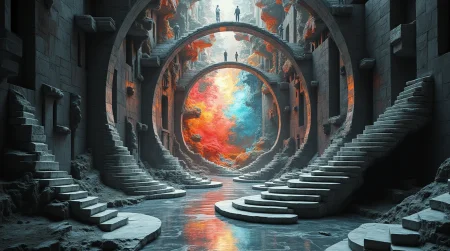


A blind man, weathered and worn, stands as the central figure, aiming a gun skyward with a defiant expression. The focus is on the act of "shooting at the world," a moment of futile rage. The composition is tight, emphasizing the man's face and the weapon. Render in a gritty, photorealistic style with a sepia-toned palette, reminiscent of Depression-era photography, capturing the harsh realities and desperation of the subject.

A chaotic construction site with smoldering, melted GPUs scattered among tangled wires and broken server racks, illuminated by sparks and flickering emergency lights, surrounded by "404 Error" and "Site Under Maintenance" holographic projections floating in the air, a stressed-out programmer frantically typing on a floating keyboard amidst swirling clouds of binary code, oversized unpaid bills raining down from above, glitching reality with fragmented pixels and distorted perspectives, shattered glass-like fragments of websites suspended in mid-air, a surreal landscape of error messages and loading screens stretching to the horizon, mind-bending optical illusions and impossible geometries warping the scene, vibrant neon colors clashing with muted, burnt-out tones, hyper-detailed textures and photorealistic rendering, dramatic lighting with strong contrasts and lens flares, extreme wide-angle perspective with deep depth of field, cinematic composition following the rule of thirds, intricate foreground elements drawing the eye into the image, 8K resolution, ultra-sharp focus, award-winning digital art, trending on ArtStation, mind-shattering, reality-defying, breathtakingly surreal.
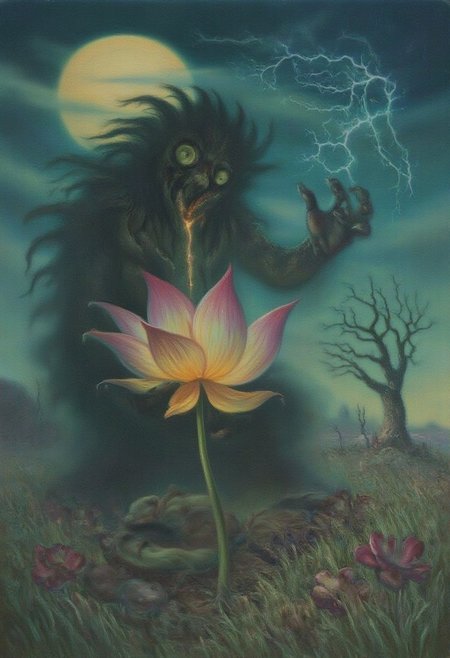
magr1 illustration. An ancient, iridescent lotus with fractal-patterned petals and sun-bleached edges is clutched by a shadow-wreathed entity with gnarled, obsidian claws, its form dissolving into ash-toned smoke, set against a dusk-lit desolate meadow under a stormy sky streaked with crackling lightning. Bioluminescent veins pulse within the flower, casting a faint amber glow against the entity’s cold moonlight silhouette, evoking melancholic duality—decay versus lingering warmth. Stylized with Zdzisław Beksiński’s surreal dystopian textures and Alphonse Mucha’s flowing lines, using muted slate and ash contrasts against vibrant saffron-crimson blooms, rendered in chiaroscuro with shallow depth of field for haunting, ethereal tension.

A mesmerizing abstract scene unfolds with silk-like threads swirling in the wind. Whirls of vibrant colors dance gracefully,creating an ethereal ballet. The atmosphere is filled with a sense of hope as delicate mists weave through the air,enhancing the dreamlike quality of the moment. The interplay of light and shadow adds depth to the scene,making the silk strands shimmer and glow with an otherworldly radiance.,

This impressive landscape photograph shows a picturesque scene in the early morning in a wintry meadow landscape. Two trees stand in the centre of the picture, one on a small island and the other on the shore, their bare branches stretching like veins against the sky. The surrounding ground is covered in a thin layer of snow, marking the transition to the calm, reflective water. A fine veil of mist hovers over the water, lending the scene a mysterious, almost mystical flair. A gentle mountain rises in the background, partially obscured by the clouds, while the rising sun breaks through the haze and casts a soft, golden light over the landscape, contrasting the cold of winter with the warmth of the light.

A surreal fantasy aerial perspective looking downward at four towering ancient oak trees arranged in a rigid square formation, their colossal trunks fused at the canopy into a massive root-and-branch platform that suspends a grand Greek temple mid-air. The temple—crafted from ivory marble with fluted columns, a golden domed roof, and intricate laurel friezes—rests atop the intertwined arboreal structure, supported by the trees like colossal pillars. Below, between the tree trunks, lie four symmetrical mirror-like ponds teeming with pink sea roses, their surfaces reflecting the floating temple. The scene is enveloped in swirling mist, with emerald forests fading into cerulean skies pierced by sunbeams casting prismatic light. Style fuses Roger Dean’s organic grandeur with Zdzisław Beksiński’s structural surrealism. Color palette: jade-green foliage, azure reflections, ivory stone, and gilt accents. Composition rules: strict geometric symmetry, temple centered on the rule of thirds, hyper-detailed textures, and layered atmospheric haze to emphasize elevation.

A frail, Smeagol-like heroine, ugly yet overflowing with surreal power, stands in a desolate landscape, a single light hinting hope; fantastical portrait, glowing eyes, dynamic shadows, in the haunting style of Dave McKean and Brian Froud
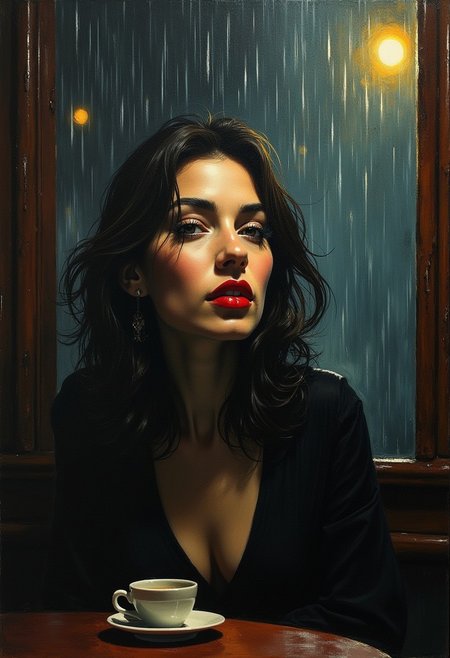
A woman's face, reduced to an abstract form, floats in a dimly lit Parisian café, late at night. Rain streaks the windowpanes, casting long, distorted shadows. The air is thick with the scent of coffee and Gauloises cigarettes. Her lips, a vibrant, defiant red, are the only splash of colour in the muted scene. A sense of melancholic solitude pervades the atmosphere. An impressionistic oil painting with loose brushstrokes on a textured canvas, capturing the dreamy ambiance of a rainy night in Paris, contrasted with the sharp, graphic features of the abstract face.
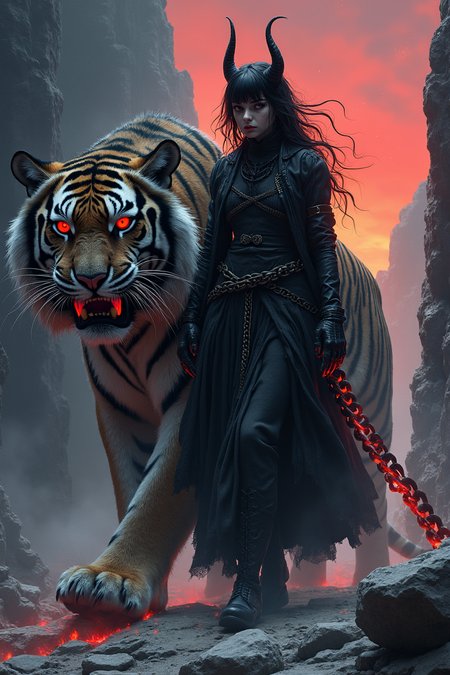
Full-length portrait of a sinister demon girl with obsidian horns, glowing crimson eyes, and clawed hands, striding confidently with a colossal sabre-tooth tiger bound by a molten chain leash. Style: Fusion of Zdzisław Beksiński’s surreal dystopian atmosphere (organic, biomechanical textures), Frank Frazetta’s primal dynamism (muscular anatomy, dramatic lighting), and Ayami Kojima’s gothic elegance (flowing robes, intricate patterns). Medium: Ethereal digital painting with ink-like precision and smoky, smoldering textures. Color palette: Deep blood-red, charcoal black, and ash-gray tones, with neon violet accents on the tiger’s spectral stripes and the demon’s smoldering chain. Composition: Diagonal layout emphasizing movement; the tiger’s snarling muzzle contrasts with the girl’s calm, predatory smirk. Background: Jagged obsidian cliffs under a bruised twilight sky, lit by a dying star. Rules: Hyper-detailed textures on the tiger’s fur and the demon’s scales, zero warm colors except crimson glows, chiaroscuro lighting to enhance menace, and a blurred motion effect on the chain to imply supernatural control. Forbid cuteness or cartoonish styles; prioritize haunting, mythic grandeur.
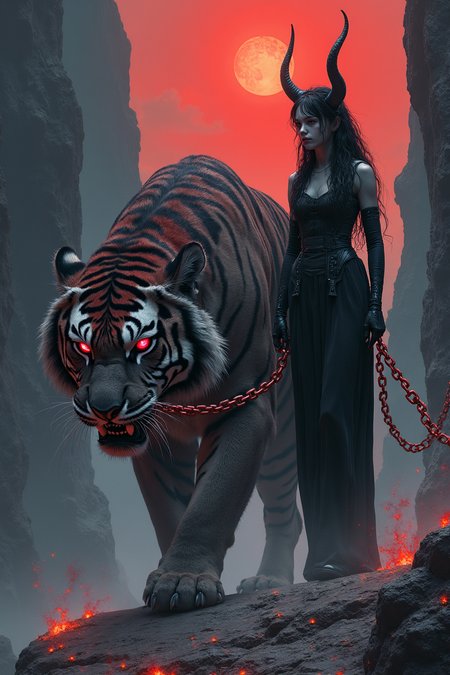
Full-length portrait of a sinister demon girl with obsidian horns, glowing crimson eyes, and clawed hands, striding confidently with a colossal sabre-tooth tiger bound by a molten chain leash. Style: Fusion of Zdzisław Beksiński’s surreal dystopian atmosphere (organic, biomechanical textures), Frank Frazetta’s primal dynamism (muscular anatomy, dramatic lighting), and Ayami Kojima’s gothic elegance (flowing robes, intricate patterns). Medium: Ethereal digital painting with ink-like precision and smoky, smoldering textures. Color palette: Deep blood-red, charcoal black, and ash-gray tones, with neon violet accents on the tiger’s spectral stripes and the demon’s smoldering chain. Composition: Diagonal layout emphasizing movement; the tiger’s snarling muzzle contrasts with the girl’s calm, predatory smirk. Background: Jagged obsidian cliffs under a bruised twilight sky, lit by a dying star. Rules: Hyper-detailed textures on the tiger’s fur and the demon’s scales, zero warm colors except crimson glows, chiaroscuro lighting to enhance menace, and a blurred motion effect on the chain to imply supernatural control. Forbid cuteness or cartoonish styles; prioritize haunting, mythic grandeur.

a basket full of white cuddle bunnies
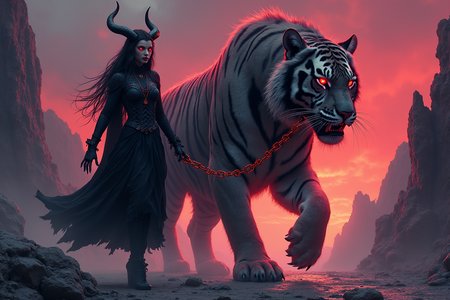
Full-length portrait of a sinister demon girl with obsidian horns, glowing crimson eyes, and clawed hands, striding confidently with a colossal sabre-tooth tiger bound by a molten chain leash. Style: Fusion of Zdzisław Beksiński’s surreal dystopian atmosphere (organic, biomechanical textures), Frank Frazetta’s primal dynamism (muscular anatomy, dramatic lighting), and Ayami Kojima’s gothic elegance (flowing robes, intricate patterns). Medium: Ethereal digital painting with ink-like precision and smoky, smoldering textures. Color palette: Deep blood-red, charcoal black, and ash-gray tones, with neon violet accents on the tiger’s spectral stripes and the demon’s smoldering chain. Composition: Diagonal layout emphasizing movement; the tiger’s snarling muzzle contrasts with the girl’s calm, predatory smirk. Background: Jagged obsidian cliffs under a bruised twilight sky, lit by a dying star. Rules: Hyper-detailed textures on the tiger’s fur and the demon’s scales, zero warm colors except crimson glows, chiaroscuro lighting to enhance menace, and a blurred motion effect on the chain to imply supernatural control. Forbid cuteness or cartoonish styles; prioritize haunting, mythic grandeur.

Minimalist surrealist landscape, hyper-detailed. A lone silhouetted figure stands centered, facing a colossal solar eclipse dominating the frame, its radiant corona glowing faintly with amber and gold filaments, perfectly aligned behind the figure. Twilight sky in deep indigo gradients, wispy cirrus clouds dissolving near the horizon. The scene reflects perfectly on a still obsidian-black lake, doubling the eclipse’s cosmic presence. Shot with a telephoto lens (300mm, f/8): compressed perspective amplifies the eclipse’s scale, dwarfing the figure. High-contrast lighting casts harsh, elongated shadows; muted monochromatic palette (midnight blues, charcoal, faint solar yellows) with subtle vignetting. Fine 35mm film grain, matte texture, and dynamic symmetry (rule of thirds for figure/eclipse alignment). Style fusion: Hiroshi Sugimoto’s minimalist long-exposure serenity + Olafur Eliasson’s luminous natural phenomena. No clutter, maximal negative space; focus on geometric harmony between figure, eclipse, and reflection.

Vibrant spring landscape with a sprawling field of golden-yellow rapeseed flowers in full bloom under a clear cerulean sky. Centred: a majestic copper beech tree with deep reddish-purple foliage. Foreground focus: a tattered scarecrow wearing a bright cobalt-blue coat and a crimson hat, standing tilted on wooden posts, surrounded by swirling petals. Tree on the left third, scarecrow on the right. Soft, diffused sunlight highlights textures (flower details, tree bark, fabric folds). Style: Blend of hyperrealism and impressionistic brushwork, inspired by Vincent van Gogh’s bold colour contrasts and Andrew Wyeth’s pastoral depth. Colour palette: Dominant golden yellows, contrasted with cobalt blue and crimson, balanced by earthy greens (tree) and muted browns (soil). Add subtle motion blur to petals for wind effect, depth of field to blur distant flowers.


Full-length portrait of a sinister demon girl with obsidian horns, glowing crimson eyes, and clawed hands, striding confidently with a colossal sabre-tooth tiger bound by a molten chain leash. Style: Fusion of Zdzisław Beksiński’s surreal dystopian atmosphere (organic, biomechanical textures), Frank Frazetta’s primal dynamism (muscular anatomy, dramatic lighting), and Ayami Kojima’s gothic elegance (flowing robes, intricate patterns). Medium: Ethereal digital painting with ink-like precision and smoky, smoldering textures. Color palette: Deep blood-red, charcoal black, and ash-gray tones, with neon violet accents on the tiger’s spectral stripes and the demon’s smoldering chain. Composition: Diagonal layout emphasizing movement; the tiger’s snarling muzzle contrasts with the girl’s calm, predatory smirk. Background: Jagged obsidian cliffs under a bruised twilight sky, lit by a dying star. Rules: Hyper-detailed textures on the tiger’s fur and the demon’s scales, zero warm colors except crimson glows, chiaroscuro lighting to enhance menace, and a blurred motion effect on the chain to imply supernatural control. Forbid cuteness or cartoonish styles; prioritize haunting, mythic grandeur.

The scene unfolds in the rain-soaked town of Bögenhafen. In the foreground, a narrow, winding street descends into a pool of shadow. The flickering gas lamps cast a sickly yellow glow, illuminating patches of glistening pavement and leaving the rest shrouded in darkness. A rat, its fur matted with rain, scurries across the street and disappears into a drain. The middle ground reveals the dilapidated buildings of Bögenhafen, their half-timbered walls rotting and warped. Awnings flap in the wind, their fabric torn and tattered. A broken window, its glass shattered on the street, reveals a glimpse of a dusty, abandoned interior. The background is dominated by the imposing silhouette of Bögenhafen's castle, its towers looming over the town like silent sentinels. A strange, green light emanates from the castle, casting an eerie glow over the mist-shrouded rooftops. The narrative subtly conveys a sense of creeping dread and the insidious nature of corruption. The emotional progression moves from initial unease to a growing sense of paranoia and the realization that something truly terrifying is lurking just beyond sight. Referencing the grimdark aesthetic of Warhammer Fantasy and the atmospheric horror of H.P. Lovecraft, the image emphasizes decay, grotesque details, and a sense of overwhelming dread. The transitions between the flickering pools of light and the suffocating darkness create a sense of disorientation and vulnerability.

A woman from behind, walking on a yellow pathway, like the path in Oz, over her circles a flock of red birds, to the side of the yellow path, are gnarled moss covered trees,

Low-angle expressive charcoal drawing: a crumbling 6-meter basalt tower ruin looms, its fractured stonework rendered with Käthe Kollwitz's stark, gritty strokes. Two weary soldiers in rough-spun tunics huddle, dwarfed at its base, dominating the foreground. Deep charcoal blacks, smudged ash greys, stark paper white define the palette. Dramatic chiaroscuro casts harsh, elongated shadows, carving pitted stone and frayed fabric textures from oppressive gloom. Wind whips fine dust, enhancing the desolate weariness. A single tattered banner fragment clings precariously above, a subtle detail echoing forgotten battles.

Full-length portrait of a haunting demon girl with pale, iridescent skin and glowing violet eyes, walking a spectral white demon bunny with cracked obsidian horns on a chain leash etched with infernal runes. Style: Fusion of Yoshitaka Amano's ethereal otherworldliness (flowing, ghostly forms), Brom's gothic horror edge (dramatic chiaroscuro, textured decay), and Audrey Kawasaki's delicate balance of innocence and menace. Medium: Ink and charcoal sketch on burnt parchment paper, with muted watercolor washes mimicking ash and smoke. Color palette: Monochromatic bone-white and void-black contrasts, with toxic green highlights on the bunny’s eyes, leash runes, and the girl’s clawed fingertips. Composition: Jagged, fractured silhouettes against an abyssal black void, gradients of ashen gray swirling around the figures to imply cursed energy. Rules: No smooth curves—only sharp, trembling ink lines; watercolor limited to smokey wisps around the bunny’s paws and the girl’s tattered dress; exaggerated hollow cheekbones and elongated limbs for unnerving proportions. Background: Faint hints of a crumbling cathedral in charcoal, no bright colors except the toxic accents. Texture: Burnt paper edges, ash splatters, and a faint bloodstain under the bunny’s paws.

Full-length portrait of a bold punk girl walking a muscular ram on a studded leash, captured in a dynamic pose with her head cocked and piercing light-blue eyes exuding seduction. Style: Fusion of Jamie Hewlett's graphic punk aesthetic (angular lines, gritty textures), John Berkey's energetic brushwork (loose, kinetic strokes), and Anna Dittmann's delicate watercolor washes. Medium: Detailed ink sketch on aged parchment paper with minimalist watercolor accents. Color palette: Stark black-and-white contrast, with vivid crimson highlights on the ram’s eyes, leash chain, and the girl’s lipstick. Composition: Bold, hard-edged silhouettes against a matte black background, gradients blending into misty gray shadows to emphasize depth. Rules: Sharp ink outlines, exaggerated perspective to highlight movement, and a focal point on the girl’s defiant expression. Textured paper grain visible, surrealist-punk fusion.

A mesmerizing color spectrum stretches across the image, transitioning seamlessly from pure black on the left through vibrant hues to deep red on the right, creating a dramatic backdrop. In the foreground, an otherworldly entity emerges from beyond the veil, its form both captivating and unsettling. The creature's ethereal presence contrasts sharply with the vivid color gradient behind it, drawing the viewer's gaze. Utilize the rule of thirds to position the entity slightly off-center, enhancing visual interest. Incorporate leading lines within the color shift to guide the eye towards the focal point. Employ dramatic lighting to accentuate the entity's otherworldly features, casting eerie shadows that blend with the darker sections of the spectrum. Create depth and dimension through subtle atmospheric perspective, with the entity appearing more defined than the background. Use complementary colors to make the creature stand out against the spectrum. Implement a slight vignette effect to frame the composition and direct attention to the center. Maintain a balanced composition by distributing visual weight evenly across the image. Render the scene in high resolution with photorealistic details, emphasizing textures and intricate features of the entity.Ensure sharp focus on the entity while allowing the background to have a slight blur, creating a sense of depth. Hyperrealistic, cinematic quality, 8K resolution, highly detailed, intricate, award-winning photography.


A towering Grim Reaper, armoured in jagged black plate and a skull mask, swings a colossal scythe forged from interlocked skulls and femurs through a necropolis of bone-choked streets. Low-angle perspective amplifies his menace, the scythe’s arc slicing dense chiaroscuro fog, casting crimson highlights from its necrotic glow. Palette: obsidian armour with tarnished gold embroidery, ash-gray ruins, and blood-rust smog. Brom’s gritty detailing meets Beksiński’s decayed surrealism—pitted iron, cracked cobblestones, skeletal hands clawing from earth. Swirling ash clings to his cloak; distant gothic spires crumble under a storm-veined sky, echoing with whispers of fallen legions.

Hyperrealistic close-up portrait of an AI artist's face (centered, symmetrical), contorted in frustration, anger, and disbelief. Key details: One half of the face subtly overlaid with translucent binary code (glitch effect, digital artifacts), sharp 8K textures highlighting skin pores, sweat, and faint screen reflections. Blurred background depicts a chaotic studio: scattered canvases, holographic interfaces, broken robot arms, and tangled wires. Lighting: Single harsh light source (cool white) from above-left, casting dramatic shadows, with rim lighting accentuating the glitch. Style: Cyberpunk-meets-contemporary-portraiture, inspired by Jason Seiler's hyperrealism and Beeple's digital dystopia. Color palette: High-contrast teal and burnt orange, neon magenta accents in the glitch. Composition rules: Centered symmetry for the face, asymmetrical background chaos; depth-of-field gradient from sharp (face) to soft (background); glitch confined to the right hemisphere without obstructing facial expression.

Full-length portrait of a haunting demon girl with pale, iridescent skin and glowing violet eyes, walking a spectral white demon bunny with cracked obsidian horns on a chain leash etched with infernal runes. Style: Fusion of Yoshitaka Amano's ethereal otherworldliness (flowing, ghostly forms), Brom's gothic horror edge (dramatic chiaroscuro, textured decay), and Audrey Kawasaki's delicate balance of innocence and menace. Medium: Ink and charcoal sketch on burnt parchment paper, with muted watercolor washes mimicking ash and smoke. Color palette: Monochromatic bone-white and void-black contrasts, with toxic green highlights on the bunny’s eyes, leash runes, and the girl’s clawed fingertips. Composition: Jagged, fractured silhouettes against an abyssal black void, gradients of ashen gray swirling around the figures to imply cursed energy. Rules: No smooth curves—only sharp, trembling ink lines; watercolor limited to smokey wisps around the bunny’s paws and the girl’s tattered dress; exaggerated hollow cheekbones and elongated limbs for unnerving proportions. Background: Faint hints of a crumbling cathedral in charcoal, no bright colors except the toxic accents. Texture: Burnt paper edges, ash splatters, and a faint bloodstain under the bunny’s paws.

Samurai meditating atop a floating shrine, ukiyo-e woodblock print with holographic gradients by Hokusai x Syd Mead, muted indigo and gold with neon cyan accents | surrounded by fractal storm clouds, cherry blossoms disintegrating into pixels, tranquil yet foreboding, rain-soaked stone textures, faint hum of energy

A surreal portrait merging the superhero genre with fantastical elements, a figure whose physical form appears weak and ugly, yet this outward frailty is utterly belied by the incredible, godlike power he emanates. The scene is steeped in a dreamlike atmosphere where reality warps around him. His eyes glow with an otherworldly luminescence, casting dynamic shadows that play across his features, emphasizing the juxtaposition between his supposed weakness and his tangible strength. The overall aesthetic leans into a surreal and fantastical realm, creating a visual paradox where the impossible becomes real, capturing the essence of a hero whose power transcends physical limitations; rendered with the unsettling, dreamlike quality of Zdzisław Beksiński and the fluid, warped perspectives of Salvador Dalí, aiming to convey a sense of both awe and unease.

Full-length portrait of a haunting demon girl with pale, iridescent skin and glowing violet eyes, walking a spectral white demon bunny with cracked obsidian horns on a chain leash etched with infernal runes. Style: Fusion of Yoshitaka Amano's ethereal otherworldliness (flowing, ghostly forms), Brom's gothic horror edge (dramatic chiaroscuro, textured decay), and Audrey Kawasaki's delicate balance of innocence and menace. Medium: Ink and charcoal sketch on burnt parchment paper, with muted watercolor washes mimicking ash and smoke. Color palette: Monochromatic bone-white and void-black contrasts, with toxic green highlights on the bunny’s eyes, leash runes, and the girl’s clawed fingertips. Composition: Jagged, fractured silhouettes against an abyssal black void, gradients of ashen gray swirling around the figures to imply cursed energy. Rules: No smooth curves—only sharp, trembling ink lines; watercolor limited to smokey wisps around the bunny’s paws and the girl’s tattered dress; exaggerated hollow cheekbones and elongated limbs for unnerving proportions. Background: Faint hints of a crumbling cathedral in charcoal, no bright colors except the toxic accents. Texture: Burnt paper edges, ash splatters, and a faint bloodstain under the bunny’s paws.

A fashion portrait of an Asian woman in profile against a vibrant turquoise background, sharp black geometric bob haircut with straight bangs, porcelain skin, ultra-glossy bold red lips, dramatic winged eyeliner, red eyeshadow, wearing an avant-garde black and white geometric patterned coat with red and orange accents, floral details, high fashion editorial, studio lighting with strong contrast, minimalist composition, clean sharp details, style of Chen Man and Nick Knight, ultra-detailed, fashion photography, high end retouching, 85mm lens, High resolution, sharp focus, commercial photography, Vogue style


In a shadowy alley, a captivating young blonde woman emerges from the darkness, her piercing blue eyes gleaming with mischief and danger. She wears a vibrant, form-fitting Spider-Man hoodie, its bold red and blue hues a stark contrast to the gritty urban backdrop. Her posture exudes confidence and aggression, yet a hint of playfulness lingers in her sly smile. Golden locks cascade from beneath the hood, framing her delicate features in soft waves. The hoodie's zipper is partially undone, revealing a glimpse of pale skin and a spider-web tattoo. Her stance is both alluring and intimidating, poised as if ready to pounce or flee at a moment's notice. Neon lights from nearby signs cast an eerie glow, accentuating the curves of her silhouette and the sheen of her leather pants. Sharp shadows dance across her face, emphasizing her angular cheekbones and the determined set of her jaw. In one hand, she casually twirls a set of keys, while the other rests on her hip, fingers splayed like a spider's legs. The atmosphere is charged with tension and mystery, inviting the viewer to question whether she's a hero, villain, or something in between. This scene captures the essence of duality, blending cute and dangerous, innocence and aggression, in a visually striking composition reminiscent of the noir-infused works of Frank Miller, with the vibrant colour palette and dynamic poses of J. Scott Campbell.

A captivating portrait merging diverse artistic styles,featuring a blonde woman donning a Spider-Man themed hoodie. The composition draws inspiration from classic comic book panels,with bold outlines and dynamic framing,while incorporating elements of pop art's vibrant color palette and repetitive patterns. Street art influences manifest in stylized background details and textural overlays. The subject's pose exudes confidence,echoing the superhero's iconic stances. Dramatic lighting casts web-like shadows,enhancing the image's depth and atmosphere. Photorealistic details in the woman's face and hair contrast with more abstract,graphic elements in her clothing and surroundings. Splashes of primary colorsârich reds,deep blues,and bright yellowsâpunctuate the scene,creating visual excitement. The overall effect is a harmonious blend of comic book energy,contemporary urban edge,and fine art sophistication,celebrating the enduring appeal of Spider-Man while presenting a fresh,modern interpretation.,

A young man in a ragged, torn suit standing in the middle of a desolate, post-apocalyptic landscape. Rusted cars and crumbling buildings dot the horizon, but the man's unwavering gaze and resolute stance suggest a refusal to be broken by the harsh environment. Style: Dystopian, gritty documentary photography Artists: Robert Frank, Gilles Peress, Wim Wenders


A low-angle shot frames Smurfette’s petite yet commanding stature, her luminescent cerulean skin glowing like twilight against gnarled obsidian trees in a haunted mushroom forest. Goth-punk reinvented: her sapphire limbs draped in a tattered ivory gown, silver septum and orbital piercings glinting under moonlight that pools in her vivid cobalt eyes. Jessica Drossin’s chiaroscuro dramatizes her elfin Smurf features—delicate pointed ears, a smattering of freckles like stardust—as she strides past bioluminescent toadstools, combat boots crushing withered violets. Velvety moss clings to a bone-white smurf cap tilted defiantly, its fabric frayed into spiderweb lace. Hyperreal textures render every pore, every dewdrop on blackberry brambles snagging her gossamer sleeve. Midnight tones pierced by electric indigo, life-sized and razor-sharp.

A compelling Polaroid-style portrait capturing a woman's reflection in a weathered club bathroom mirror, the harsh fluorescent lighting adding authenticity to her intense gaze. Her natural blonde hair frames angelic features, while smudged eyeliner and lipstick tell stories of a long night. Beads of perspiration catch the light, her white blouse slightly rumpled from the humid atmosphere. The composition embraces the raw, unfiltered aesthetic of 1970s punk documentation photography, channeling Nan Goldin's intimate portraiture style and Cindy Sherman's identity exploration work. The degraded bathroom tiles and graffiti-marked walls add contextual grittiness, while the Polaroid format's characteristic color saturation and vignetting enhance the captured moment's authenticity.

A monolithic black-and-white marble sphere rests in an infinite void, its polished surface veined with pearlescent gray and onyx. From a fissure at its apex, a humanoid figure emerges, limbs coalescing in viscous, obsidian-like strands. Low-angle close-up, chiaroscuro lighting casts elongated shadows, highlighting the sphere’s fractal hieroglyphs and the figure’s fragmented silhouette. Influenced by Zdzisław Beksiński’s surreal organicism and H.R. Giger’s biomechanical textures. Monochromatic palette shifts under diffused amber light, cracks emitting faint bioluminescence. Atmosphere of eerie stillness, the figure’s hollow eyes reflecting distant starlight—an ancient entity awakening in silent cosmic ritual.

An ancient, leather-bound book lies open, its pages yellowed and stained with what looks like dried blood. Grotesque symbols, pulsating with an unholy light, writhe across the surface of the parchment. This is the Necronomicon, a tome of forbidden knowledge and unspeakable horrors. From its depths, shadowy tendrils emerge, coalescing into twisted, demonic forms that claw their way into the physical world. The scene is lit by an eerie, flickering light, casting long, distorted shadows that dance and writhe like living things. The very fabric of reality warps and twists, reflecting the encroaching chaos. This is a descent into the heart of cosmic horror, a visual representation of the terrors unleashed by the Evil Dead. The style evokes the biomechanical nightmares of H.R. Giger, combined with the visceral, grotesque imagery of Zdzisław Beksiński. The desired emotion is a profound sense of dread and revulsion, a glimpse into the abyss of the unknown. The rendering is highly detailed, with a focus on texture and the interplay of light and shadow to create a deeply unsettling and immersive experience. The color palette is dark and muted, with occasional bursts of sickly, unnatural hues to highlight the demonic elements.


Ultra-detailed photograph of a translucent glass flask, half-buried in ultra-fine, intricate sand dunes. Inside the flask, a translucent, glowing jinn with swirling smoke and fiery details emerges dynamically, clawing at the glass walls. Style: Hyper-realistic fantasy with influences from James Gurney's luminous color palettes and Moebius' intricate linework. Color composition: Sapphire and amber hues for the flask, golden-beige sand with subtle iridescence, fiery orange-red gradients for the jinn, and a twilight sky with indigo-to-violet gradients. Image rules: Use the Rule of Thirds (flask centered-left), dynamic diagonal lines from escaping smoke, and atmospheric perspective (soft-focus sand in background). Lighting: Dramatic backlighting from the flask's glow, sharp refractive details on the glass, and volumetric dust particles in the air.


A resplendent golden warrior,clad in emerald-tinged armor etched with crimson runes,stands triumphant atop a windswept hill,his hammer raised high in devotion to Sigmar. The scene,reminiscent of Frazetta's dynamic compositions and Turner's ethereal lighting,bathes in a celestial glow that pierces through ominous storm clouds. Swirling brushstrokes evoke Van Gogh's turbulent skies,while Klimt-inspired geometric patterns adorn the warrior's flowing cape. The landscape below unfolds in a tapestry of verdant fields and amber wheat,punctuated by scarlet poppies that dance in an unseen breeze. A distant citadel,its spires reaching skyward,gleams with an otherworldly radiance,its architecture a fusion of Gothic and Art Nouveau styles. The air crackles with tangible energy,hinting at imminent divine intervention. Hyper-detailed textures bring every element to life,from the weathered leather of the warrior's gauntlets to the individual blades of grass at his feet. A sense of epic scale pervades the composition,with the warrior dominating the foreground while the vast,tumultuous world stretches endlessly behind him. The overall mood is one of awe-inspiring power tempered by a touch of melancholy,as if capturing a fleeting moment of glory before the tides of fate shift once more.,

Manga sketch style, ink-textured crosshatching, dynamic line weight. Teenagers lean on a rusted fire escape, shared matcha-green tea ice cream dripping glossy rivulets. Low-angle perspective, neon-soaked Tokyo sprawl below, blurred bokeh traffic streaks. Katsuhiro Otomo’s intricate linework meets Makoto Shinkai’s gradient skies: pastel pistachio and azure creams contrast monochrome concrete. Golden-hour backlighting casts elongated shadows through wrought-iron railings, catching sugar crystals on lips. Stray calico observes from corrugated rooftop, tail flicking. Distant train horns warp in humid air, melted treat pools between sneakers – fleeting summer communion.