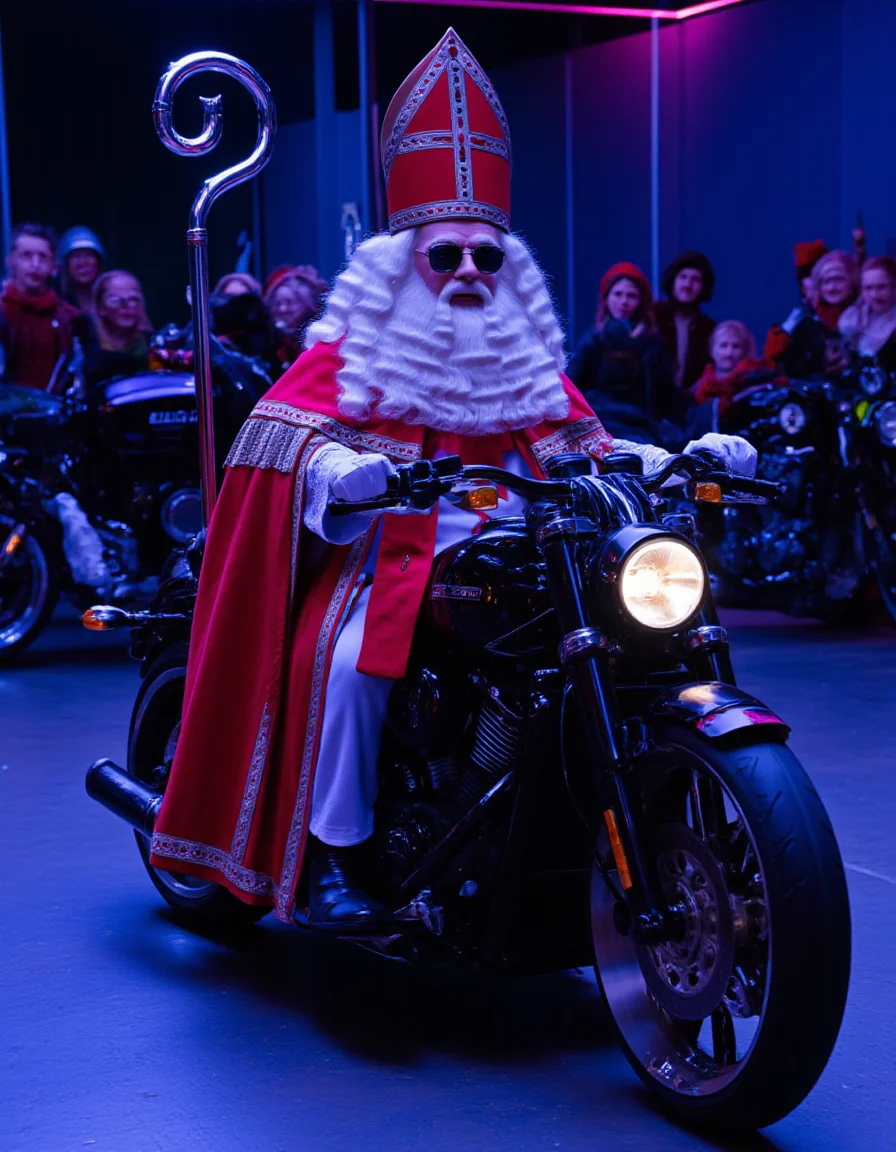
Imagine Sinterklaas in a sleek, neon-lit motorcycle garage at midnight, surrounded by an array of shiny, futuristic bikes. The garage is dim, with only streaks of neon blue and purple lights cutting through the shadows, casting his crimson robes in sharp contrast to the metallic gleam of chrome and polished engines. Sinterklaas himself is astride a powerful, custom-built motorbike, black with intricate silver detailing that swirls around the frame like vines. His traditional red cloak is draped over him, flowing down behind like a cape, while his miter (bishop’s hat) is swapped out for a gleaming, open-face helmet with the same iconic cross emblazoned on the front. His white beard flows out, catching the light as if it has a glow of its own, and his black gloves grip the handlebars, fingers poised as though he’s about to rev the engine. Instead of his usual staff, a futuristic silver baton with a glowing blue tip is strapped to his back, pulsing faintly in the dim light, as if charged with energy. His eyes are fixed forward, framed by a pair of aviator sunglasses, reflecting the neon light. Behind him, his “team” — a group of similarly outfitted young bikers — leans against their motorcycles, some sporting festive scarves or red accents, ready to follow him in an epic midnight ride. The whole scene has a surreal, cinematic feel, like a still from an alternate-universe heist movie, where Sinterklaas isn’t delivering gifts on horseback but leading a holiday rebellion on a fleet of roaring, neon-lit motorcycles. <lora:Sinterklaas:1.8> Sinterklaas
Parameters used to generate this content
Copies the original metadata text embedded by AUTOMATIC1111.
AI models used to generate this content