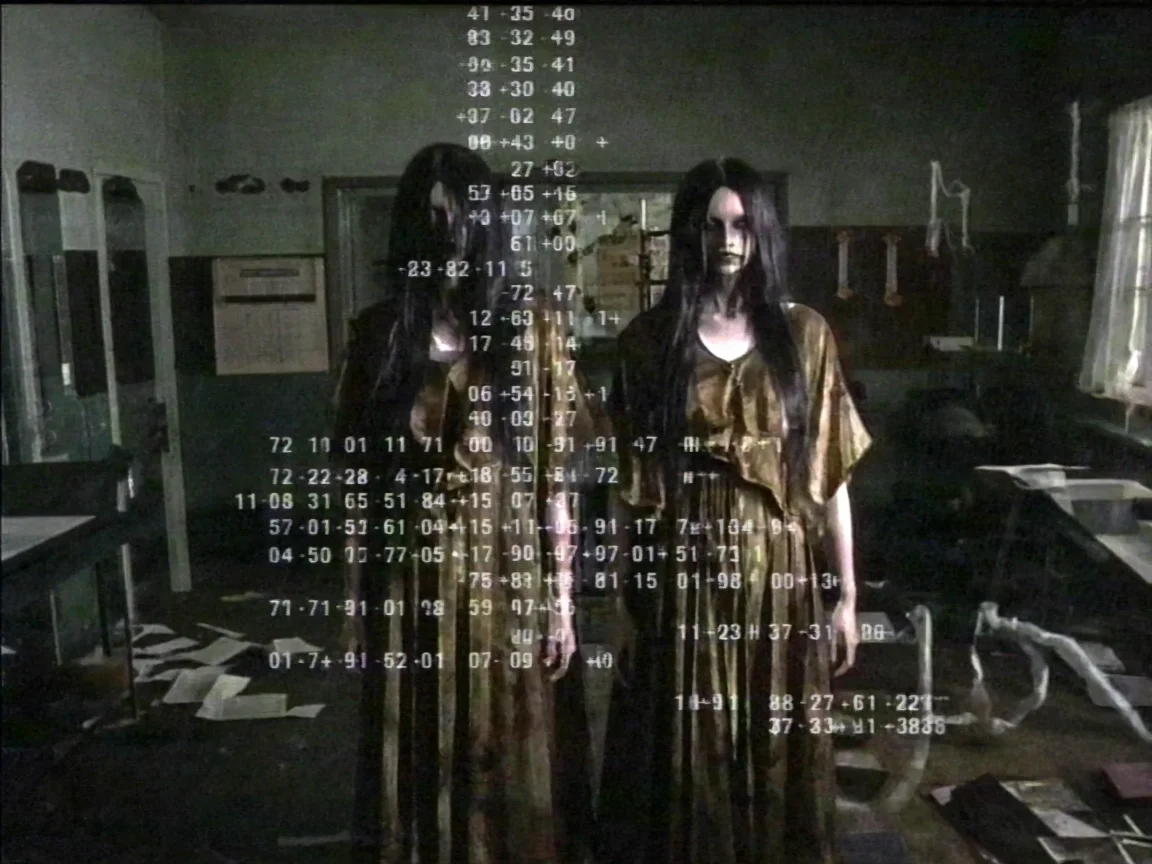
hi8 camcorder footage, amateur home-video still, low-resolution color, soft analog edges, heavy tape noise, mild chroma bleed, harsh direct camera light, no cinematic grading. Inside a dark, abandoned medical facility room, two pale women stand motionless side by side. Their faces are completely obscured by long, straight black hair that hangs forward, swallowing their features in shadow. They wear loose, draping brown garments that fall heavily around them, the fabric appearing worn and mottled in the dim illumination from the camcorder’s built-in light. Their skin reflects the light in flat, washed-out tones, with edges breaking into interlacing artifacts. The walls around them are cracked, stained, and peeling, showing remnants of old medical signage and faded paint. Rusted metal fixtures protrude from the walls, and a toppled examination table lies in the corner, barely visible beyond the reach of the camera light. The floor is littered with debris—papers, broken tiles, and disconnected tubing—though most details dissolve into deep grain as the Hi8 sensor struggles with the surrounding darkness. Across the entire image, excessive numbers appear as white text overlaid chaotically, as if from a malfunctioning timecode or corrupted recording: repeating sequences, stacked digits, and jittering characters that flicker and smear into the frame. Some numbers drift toward the edges, partially transparent, giving the footage a warped and unstable feeling. Shadows around the women pulse slightly as the camera light shifts, creating uneven exposure that blooms around their silhouettes. The overall scene feels like disturbing, shaky found-footage from a neglected medical wing: muted sharpness, unstable white balance, harsh shadows, flickering overlays, chroma smear, and the unmistakable soft, analog texture of Hi8 camcorder video.
Parameters used to generate this content
The node graph used to generate this content — pan and zoom to explore, or download it to run in ComfyUI.
AI models used to generate this content