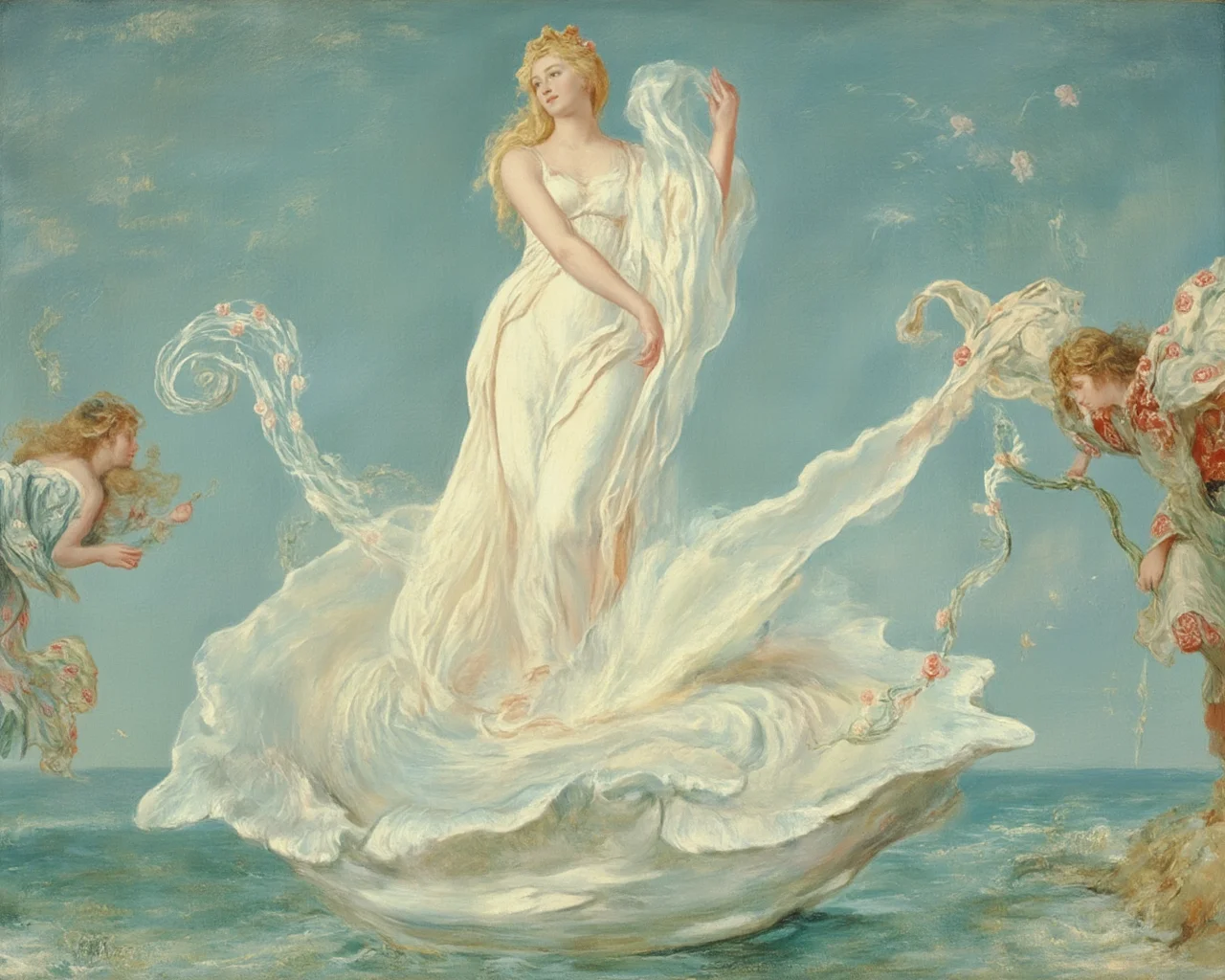
pprbenz, The scene unfolds in a dreamlike, luminous world where the sea meets the sky in soft tones of turquoise and gold. At the center stands Venus, newly born yet fully divine, rising not from a literal shell but from a flowing abstraction — a pale, spiraling form of light and motion, like a sculpted wave or a swirl of pearl and mist. Her posture remains serene and graceful, her gaze both innocent and knowing, as though she has just awakened to the beauty of existence itself. She is clothed now in a flowing white gown of ethereal fabric, the kind that seems woven from air and light. The dress drapes elegantly around her body, cinched gently at the waist, its folds catching the ocean breeze. The fabric glows faintly, almost translucent at the edges, shimmering with hints of silver and cream. Her long golden hair still ripples around her, mingling with the soft wind that moves through the scene, but the gown gives her an aura of celestial grace — modest yet radiant, pure yet alive with sensual harmony. To her left, the wind gods hover in a tender embrace, blowing a gentle current that sends flowers spiraling through the air. Their garments twist in motion, echoing the rhythm of the waves below. To the right, a woman in a rose-patterned cloak rushes forward to greet Venus, extending the fabric as if to shield her from the morning breeze. The entire composition feels like a living breath — the movement of birth and awakening translated into color and light. The abstracted shell beneath Venus is no longer a solid object, but a symbol of emergence — a bridge between sea and sky, material and divine, reality and dream. The scene radiates tranquility and renewal, capturing beauty as something timeless, soft, and ever-becoming.
Parameters used to generate this content
The node graph used to generate this content — pan and zoom to explore, or download it to run in ComfyUI.
AI models used to generate this content