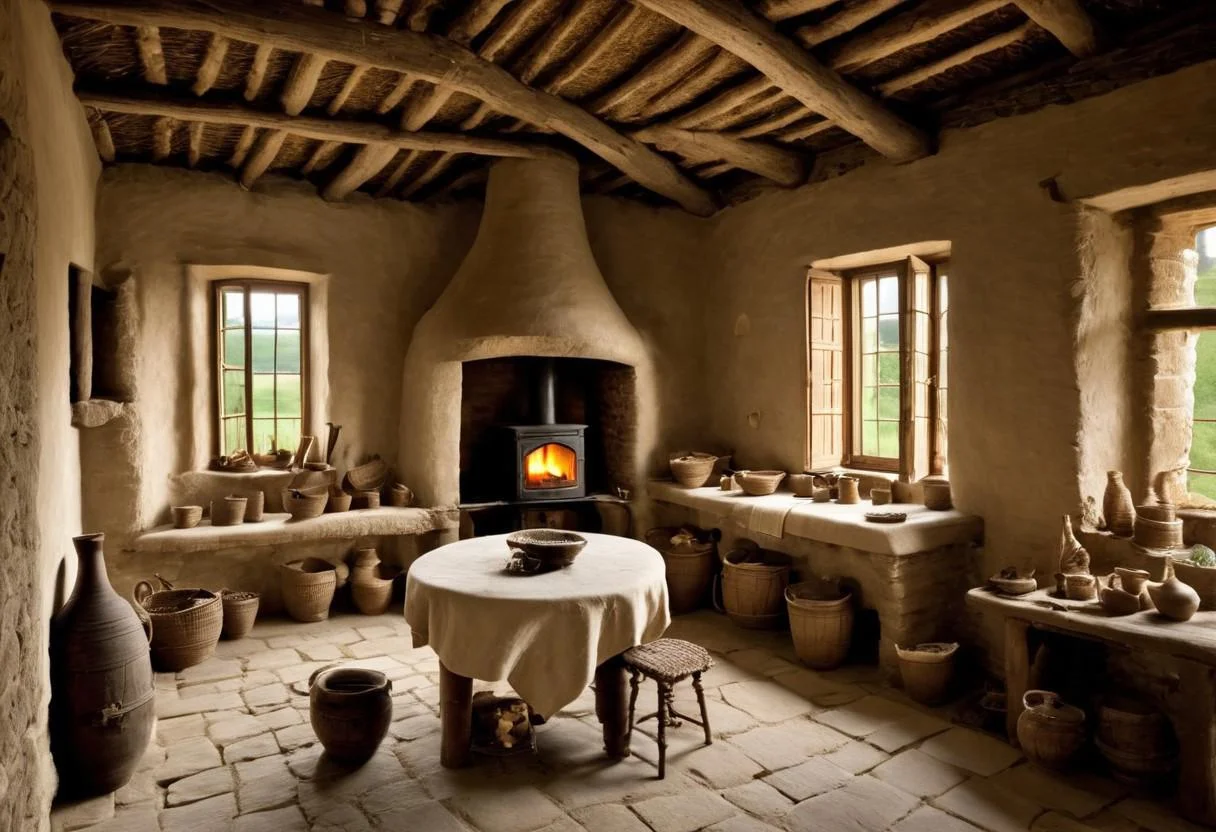
Space and structure One or two rooms: Most houses had one main room, which was used for all activities—cooking, eating, sleeping, and working. Wealthier families or houses from the late medieval period may have had a separate kitchen or a small "solarium" (a private room for the family). Materials: Walls were made of wood, wattle and daub, or stone in wealthier homes. Roofs were made of straw or wooden planks. 2. Floors and lighting Floors: Covered with compacted earth, straw, or reeds, which were changed periodically to absorb moisture and odors. Lighting: Small windows (often without glass, only with wooden shutters) let in dim light. Candles, animal fat lamps, or lucillos were used in the evening. Smoke from the hearth also darkened the walls. 3. Hearth and Heating Central hearth: A fire in the middle of the room or against a wall for cooking and heating. Chimneys did not appear until the late Middle Ages, so the smoke would escape through a hole in the roof, making the air dark and smoky. Kitchen tools: Iron cauldron, wooden spoons, and clay pots. 4. Furniture Minimalism: Wooden tables (often foldable), benches, or wooden chairs. Beds were simple—wooden frames with straw mattresses or hides. The wealthy had wooden beds with canopies and woolen covers.
Parameters used to generate this content
modern_elements, low_contrast, cartoon_style, oversaturated_colors, flat_lighting, deformed_perspective blurred_details, plastic_texture ,(worst quality, low quality, normal quality: 1.4), low resolution, blurry, (bad anatomy, wrong hand: 1.2), ugly, veneer, badly drawn hands, badly drawn legs, badly drawn face, out of frame, extra limbs, disfigured, deformed, body out of frame, blurred, bad anatomy,e: flat_lighting, pixelation, distorted_perspective (low_quality:1.4), (blurry:1.3), (malformed_hands:1.5), (asymmetrical_wings:1.4), (cartoonish:1.3), (anime_style:1.4), (overexposed_light:1.2), (flat_colors:1.3), (watermark:1.6), (text:1.5), (extra_fingers:1.4), (mutation:1.5), (poor_proportions:1.4), (modern_clothing:1.3), (peaceful_scene:1.2), (simplistic_design:1.3) "divine_angelic_warrior, intricate_platinum_armor, ... , Negative: low_quality, blurry, ..."
Copies the original metadata text embedded by AUTOMATIC1111.
AI models used to generate this content