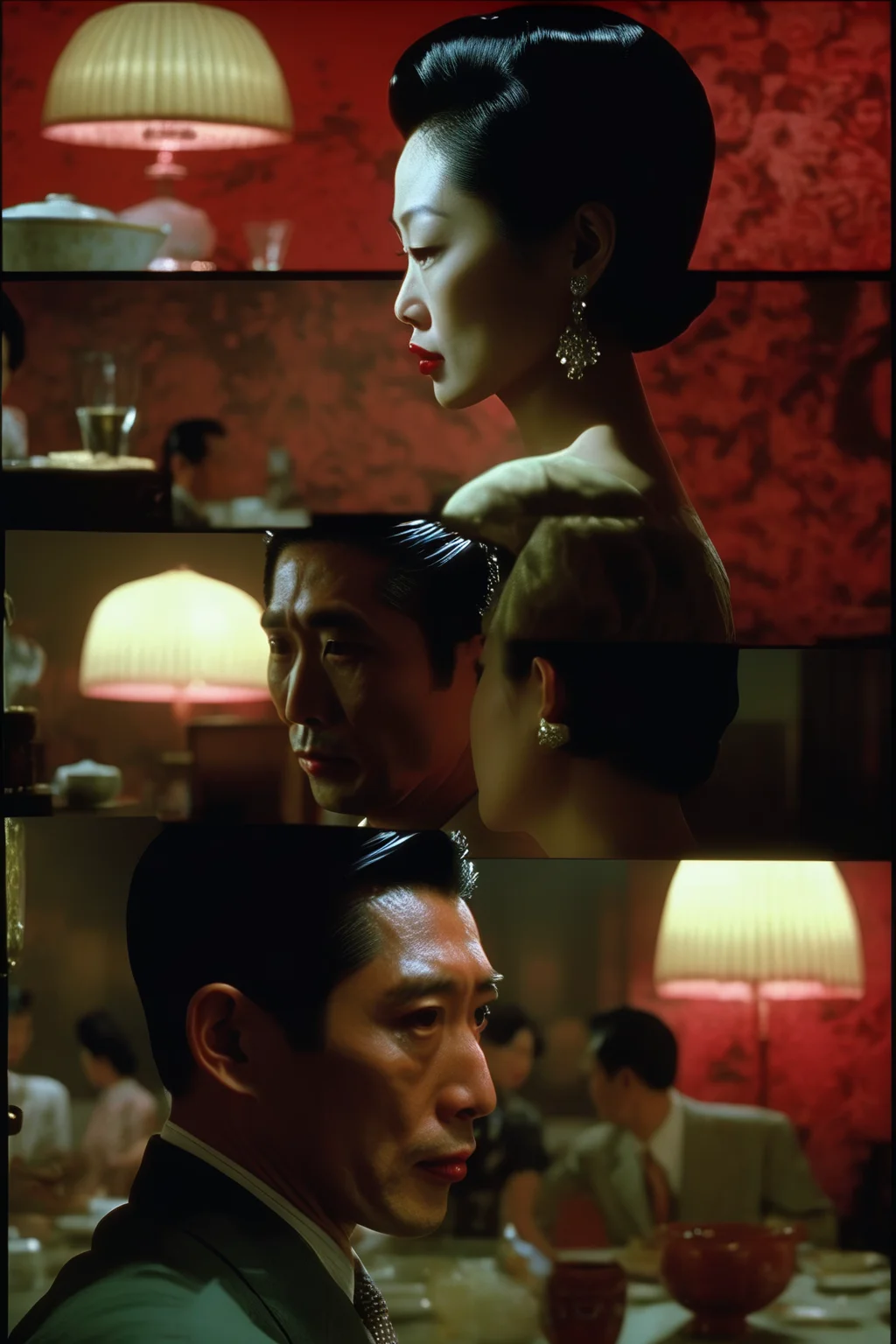
<lora:Director Wong Kar-wai style:1>Director Wong Kar-wai style - “In the Mood for Love” (2000) and all share a cinematography credit on “In the Mood for Love,” painfully elegant story of two people who are drawn together once they realize that their spouses are having an affair. But because the film is so deliberate in its use of locations, compositions, and camera angles, it’s not only impossible to pick out who shot which scenes but besides the point. Without becoming repetitive, the imagery creates a rhythm to the characters’ lives that gives us a sense of their day-to-day and the magnetic pull, of love itself perhaps, that slowly draws them together. The sense of the characters’ relationships, obligations, and even their take-out habits are continually reinforced through the DPs careful framing, trapping and within some overarching geometric framework; yet they themselves are what the camera always draws our focus to, the point that pops the most inside of each frame’s beautifully composed and sumptuously colored. For a film that was shot somewhat improvisationally over the course of 15 months, there’s an overwhelming sense of design to the look of “In the Mood for Love.” Every texture, every color, every gorgeously dense composition — to say nothing of how the tendrils of cigarette smoke suggest the ache of time passing – in every shot is composed with the goal of getting the audience to yearn for the protagonists to kiss. In every single shot, you want it. And of course, the beauty of “In the Mood for Love,” really, is that in every single shot, they don’t
Parameters used to generate this content
Copies the original metadata text embedded by AUTOMATIC1111.
AI models used to generate this content