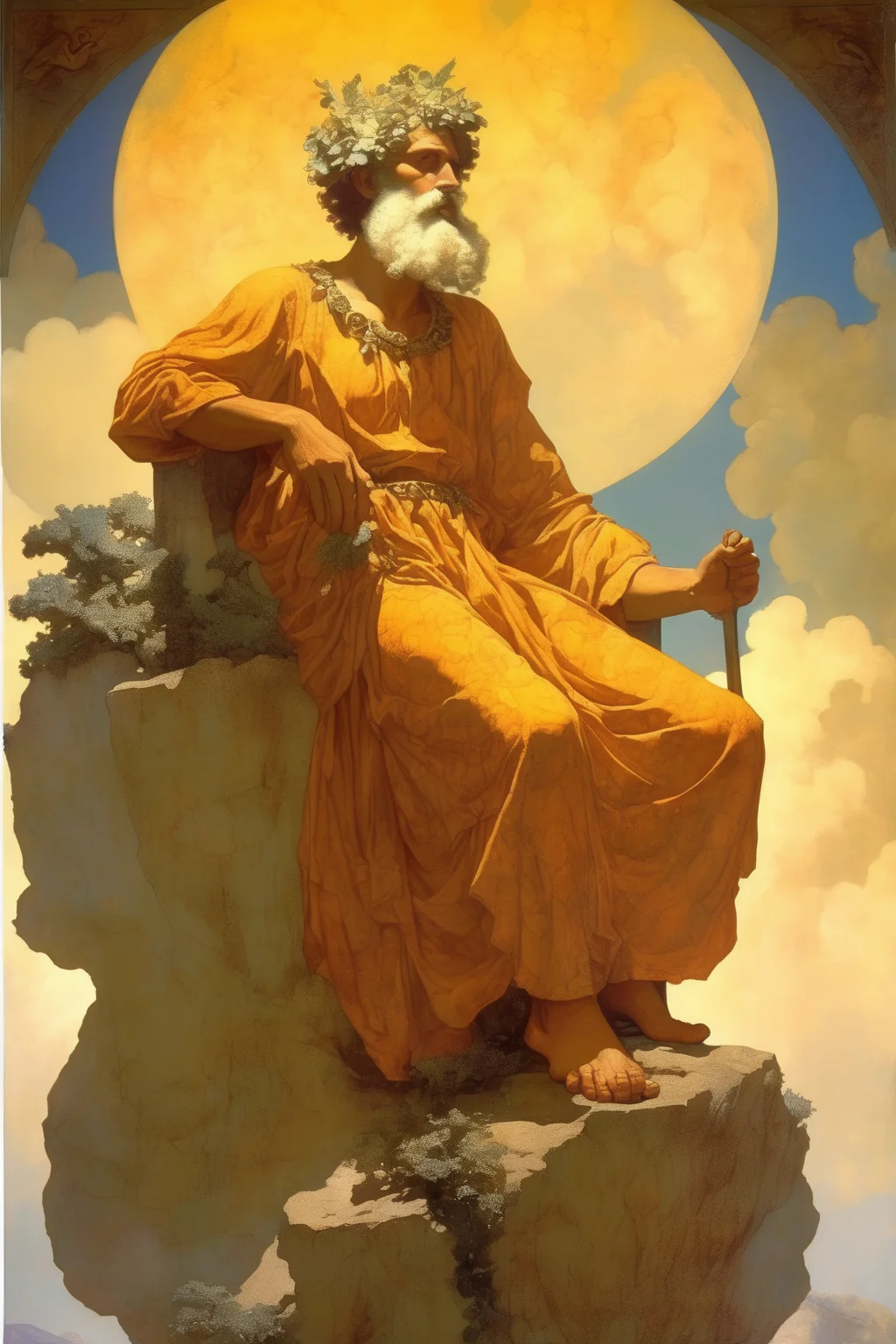
<lora:Maxfield Parrish Style:1>Maxfield Parrish Style - A Maxfield Parrish painting of - Sabaktes (Deity) Sabaktes, also known as Sabbaktes, is a deity from ancient Phrygian mythology. He is often associated with Sabazios, the horseman and sky father god of the Phrygians and Thracians, and sometimes considered an aspect of him. Sabaktes is also identified with Dionysus, the god of wine and revelry in Greek mythology, leading to a syncretic amalgamation of characteristics. Appearance: Sabaktes' appearance is subject to various interpretations due to the syncretic nature of ancient religions. Often, he is depicted as a robust, bearded man in the prime of life. Given his association with Dionysus, he might be seen wearing ivy wreaths and holding a thyrsus – a staff entwined with ivy and topped with a pine cone. If his association with the sky father god Sabazios is considered, he could be portrayed as a horseman or with symbolic items like a lightning bolt or an eagle. Ecstasy and Revelry: As an aspect of Dionysus, Sabaktes might share the ability to induce ecstatic states and uncontrolled revelry in his followers. Nature Manipulation: Dionysus' domain included the fertility of nature and vine cultivation; thus, Sabaktes might also possess powers over vegetation and nature. Thunderbolts: If considered as an aspect of Sabazios, Sabaktes could potentially wield thunderbolts or have some control over the weather, as Sabazios was a sky father god. Language: Sabaktes, as an ancient deity, would presumably understand and communicate in ancient Phrygian or Thracian languages. However, his association with Greek Dionysus suggests he might also communicate in ancient Greek. Environment: As an ancient deity, Sabaktes would have been worshipped in the Phrygian and Thracian lands, which today correspond to parts of modern-day Turkey, Greece, and Bulgaria. His environment could be anywhere from high mountains to verdant vineyards, depending on his current association. Overall, Sabaktes offers a fascinating insight into the syncretic nature of ancient religions, where gods from different pantheons often became intertwined based on similarities in their domains or characteristics.
Parameters used to generate this content
Copies the original metadata text embedded by AUTOMATIC1111.
AI models used to generate this content