🖼️ Loading...
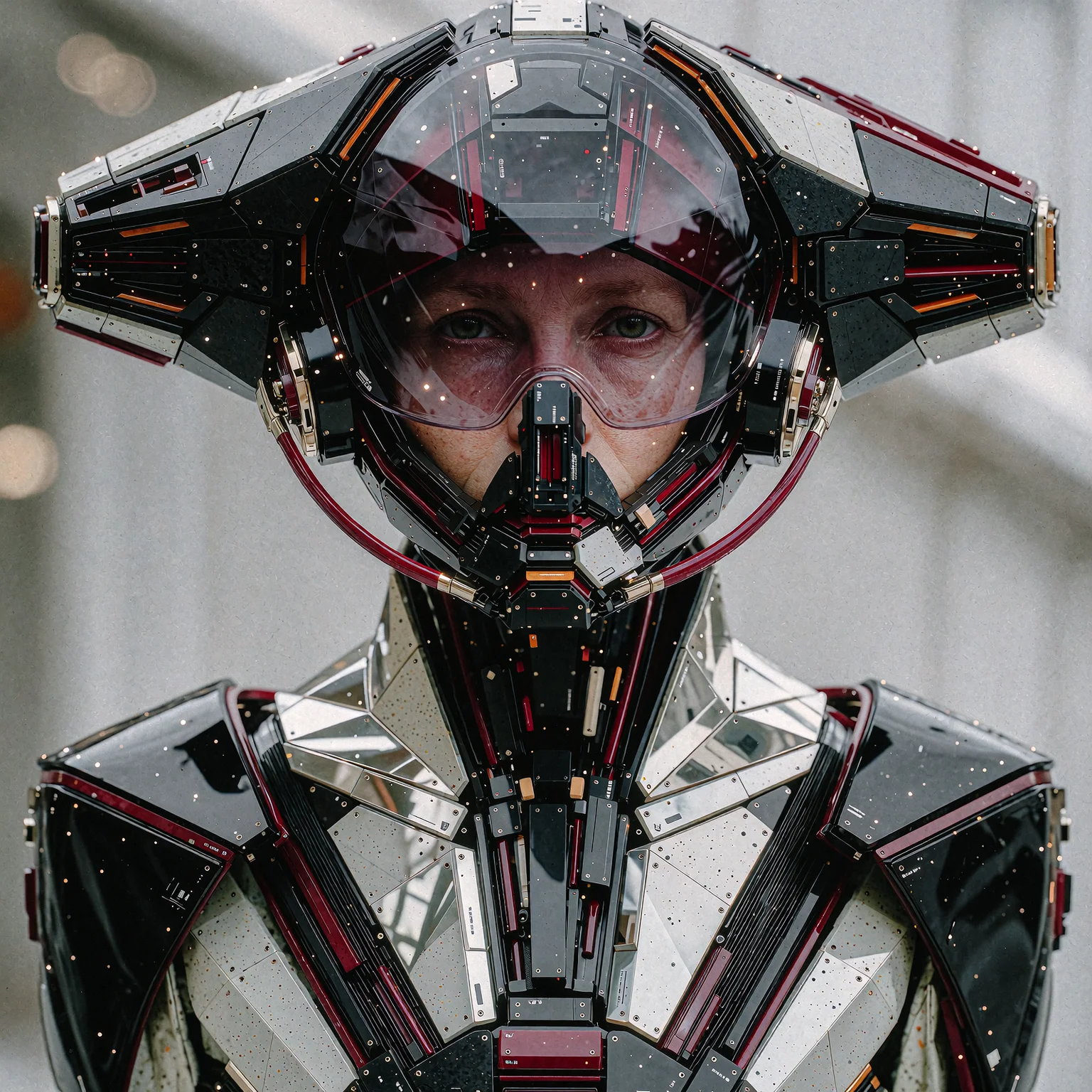
    Photorealistic post-recognizable starship command pilot portrait, photographed as a severe high-end aerospace systems editorial. The image documents elite flight equipment from a mature post-human military civilization centuries beyond contemporary aerospace engineering. The technology is physically real, manufactured, serviced, worn, and culturally codified, but its engineering logic is only partially comprehensible to a modern observer.

A slender adult starship command pilot is shown from the upper chest upward in a strict frontal portrait. The pilot faces directly toward the camera with the head held level and the shoulders squared. The gaze is intense, calm, and emotionally controlled. The pilot does not look heroic or theatrical. The expression is cold, analytical, and focused, as though silently receiving tactical information through the helmet interface.

Only the pilot's eyes and a narrow strip of upper facial skin remain clearly visible. The visible skin is natural and realistic, with fine pores, subtle under-eye texture, faint small marks, and restrained tonal variation. The eyes are sharply resolved and form the emotional center of the image.

The pilot wears an enormous integrated command flight helmet and cranial interface system in deep graphite black, smoked gray, dark crimson, pale metallic white, and sparse amber-orange accents. The helmet should feel disproportionately large and technologically dominant compared with the human head inside it. The pilot appears physically enclosed by a dense machine architecture rather than simply wearing conventional protective headgear.

The helmet has an exceptionally broad cranial silhouette. Massive lateral command structures extend outward from both sides of the upper head, creating a wide, almost ceremonial profile. These structures are functional aerospace and field-control systems, not decorative horns, wings, or costume elements.

The broad upper modules are thick, faceted, asymmetrical mechanical masses made from dark graphite metamaterial, smoked composite, black ceramic, and thin pale structural surfaces. Their forms extend laterally and slightly upward like immense cranial equipment housings. Complex internal mechanisms, recessed red structures, narrow orange photonic channels, dark cavities, layered structural ribs, and tiny illuminated technical markings are visible beneath and between the outer shells.

The upper cranial structures communicate command rank through functional complexity. Greater equipment span, greater subsystem density, and more advanced field-control hardware visibly distinguish this pilot from lower-ranking flight personnel. Rank is expressed through the architecture of the machine itself rather than conventional badges.

A dark smoked visor covers the forehead and upper face but leaves both eyes visible beneath its lower edge. The visor has deep multilayer optical construction rather than a single smooth shell. Several translucent structural strata exist at different depths. Internal red photonic lattices, buried reflective geometry, faint segmented light channels, dim symbolic telemetry, and regional changes in optical density are visible through the outer smoked material.

The visor is not a simple screen or HUD. Information appears embedded within the optical volume itself. The material acts simultaneously as sensor substrate, information medium, field interface, and protective structure.

The lower half of the pilot's face is enclosed by an extraordinarily complex respirator and neural-interface apparatus. A dense mechanical structure covers the nose, mouth, jaw, and lower cheeks. The system is visually difficult to parse because respirator components, cranial interface hardware, sensory nodes, field-control elements, fluid channels, and life-support architecture overlap and partially conceal one another.

The central facial apparatus is composed of layered black composite, dark metallic structures, small red-lit recesses, narrow pale mechanical inserts, exposed micro-fasteners, compact articulated modules, dark ribbed surfaces, and several tiny optical or sensor nodes. The machinery should feel engineered at microscopic precision.

A narrow complex respirator core sits directly over the nose and mouth. It resembles neither a gas mask nor an oxygen mask. The structure has multiple small intake-like forms, nested dark mechanical layers, red internal channels, tiny pressure structures, and small reflective elements. The viewer should not immediately understand which visible parts are responsible for breathing, neural communication, pressure regulation, sensing, or data exchange.

Thin crimson straps or flexible command restraints emerge from the sides of the facial interface and arc outward around the head. These red structural bands are flexible, slightly slack, and physically real. They introduce a faint ceremonial quality into otherwise cold machinery, suggesting that military traditions survived the technological transformation of the human-machine interface.

Dense black interface columns extend vertically from the jaw and lower helmet toward the chest. These structures create a rigid architectural bridge between skull, neck, and torso. Several dark graphite rails, black ribbed conduits, narrow red channels, and pale structural modules run downward in parallel but are not perfectly symmetrical.

The helmet, neck system, and upper torso equipment have no clean boundaries. Cranial hardware descends into the cervical interface. Jaw systems overlap neck systems. Neck architecture merges into chest structures. The viewer should not be able to easily determine where the helmet ends and the suit begins.

The pilot appears temporarily incorporated into the spacecraft's control architecture. The equipment is not merely protective clothing. It is a combined life-support system, cognitive interface, tactical data system, sensory extension, pressure enclosure, and spacecraft command link.

The upper torso is covered by an integrated black, silver-white, and dark crimson command flight system. Pale ceramic-composite armor panels form sharp geometric islands between dense dark structural architecture. Black interface machinery visually dominates the pale suit.

Large black shoulder structures curve outward and frame the torso. Their surfaces are glossy in some regions, matte in others, with narrow crimson trim lines, dark red recessed channels, and small technical markings. The shoulders feel like interface housings rather than conventional armor.

The upper chest contains several overlapping silver-white structural plates. These pale panels are sharply faceted, thin, and partially obscured by black conduits, dark mechanical rails, webbing, and vertical interface columns. The pale armor should feel interrupted and partially buried beneath the more advanced black systems.

A central vertical command architecture runs from the pilot's jaw to the lower chest. This dark graphite structure is composed of several nested modules and dense rectangular technical layers. Sparse red-orange information blocks, tiny amber symbols, partially legible system labels, maintenance markings, serial references, and restrained military data panels are embedded within it.

The small red-orange information areas are not consumer displays. They appear to be specialized maintenance or system-state surfaces intended for trained personnel. Text is tiny, partially worn, fragmented, and culturally specific.

The design should contain many subtle functional markings: narrow red stripes, tiny white geometric identifiers, small amber labels, asymmetric maintenance symbols, serial blocks, warning marks, calibration references, and faint etched diagrams. These markings are distributed sparingly and should feel like the accumulated visual language of a mature aerospace institution.

The entire design is nearly symmetrical at first glance but reveals numerous subtle asymmetries on closer inspection. Small modules differ slightly from left to right. Cable routes are not identical. Structural layers overlap differently. Some maintenance panels exist on only one side. The system has evolved around function rather than visual perfection.

The equipment is highly advanced but not pristine. Graphite surfaces show faint abrasion, microscopic scratches, handling marks, rubbed edges, and subtle polishing around frequent contact points. Pale ceramic-composite panels show tiny discolorations, softened corners, small chips, and imperfect surface texture. Flexible black materials show strain, compression, weave, and subtle deformation.

The machine architecture is technologically dense and visually ambiguous. Avoid cleanly separated design zones. The visor, cranial shell, lateral command structures, facial respirator, jaw systems, neck rails, chest interfaces, and shoulder equipment should overlap and partially conceal one another. Components emerge from beneath other components. Structures disappear into dark cavities and reappear elsewhere.

Prioritize difficult-to-parse subsystem layering over clean industrial minimalism. The viewer should feel that every visible component belongs to a highly functional system but should not be able to visually reverse-engineer the equipment.

The design is coldly engineered, not organic. No insect anatomy, bone structures, exposed flesh machinery, tentacles, biological ribs, biomechanical horror, or gothic fantasy motifs. The alien quality comes from unfamiliar engineering logic, integrated system architecture, field-based technologies, advanced material science, and centuries of accumulated military design culture.

There are no visible conventional controls, no buttons, no keyboards, no obvious touchscreens, and no recognizable cockpit interface. The equipment appears to communicate directly with the pilot through integrated sensory and cognitive coupling.

The composition is a strict frontal command portrait. The pilot's head is centered precisely in the square frame. The massive cranial structures spread outward toward the upper-left and upper-right corners, creating a broad imposing silhouette. The shoulders fill the lower corners.

The camera is positioned at approximately the pilot's eye level and directly in front of the subject. No three-quarter angle. No side profile. No dramatic tilt. The facial symmetry and intense gaze are visually important.

The pilot occupies nearly the entire frame from upper helmet to upper chest. The eyes sit slightly above the vertical center. The wide helmet structures nearly touch the left and right edges of the image. The portrait should feel confrontational in composition but emotionally restrained.

The background is pale neutral gray to cool off-white and nearly featureless. It suggests a vast luminous spacecraft environment, clean aerospace processing bay, or overexposed command facility rather than a photography studio. No readable architecture or environmental objects.

Bright soft environmental light surrounds the pilot from the front and upper sides. The pale background remains luminous and clean. The helmet and suit retain deep controlled blacks, dark graphite midtones, pale metallic panels, rich crimson accents, and sparse amber-orange technical lights.

The face is softly illuminated beneath the heavy helmet architecture. The eyes remain clear and sharply visible. Fine reflections from red internal systems subtly illuminate the lower visor, cheek area, and mechanical facial interface.

Small crimson and amber light sources glow from deep within selected cavities. The light should feel physically embedded within the machinery rather than applied as decorative LED strips. Tiny red reflections appear on neighboring black surfaces.

The smoked visor produces complex controlled reflections, including faint abstract environmental forms, buried red structures, internal dark geometry, subtle ghost reflections, and several layers of optical depth. Avoid a single smooth glossy visor surface.

High-resolution medium-format aerospace editorial photography, extreme material realism, broad highlight rolloff, restrained digital sharpness, fine natural grain, gentle optical softness, deep controlled blacks, physically believable transparent materials, microscopic surface detail, subtle halation around small internal light sources, and quiet photographic luxury.

The image should feel like a formal systems portrait of an elite command pilot from a mature post-human starflight civilization. The pilot remains recognizably human, but the human face is almost swallowed by the immense technological architecture required to operate the spacecraft.

Recognizable function, unrecognizable implementation. Severe, aristocratic, military, technologically ancient from the perspective of our own future, visually dense, borderline alien, and impossible to fully understand from appearance alone.
    Prompt

    Photorealistic post-recognizable starship command pilot portrait, photographed as a severe high-end aerospace systems editorial. The image documents elite flight equipment from a mature post-human military civilization centuries beyond contemporary aerospace engineering. The technology is physically real, manufactured, serviced, worn, and culturally codified, but its engineering logic is only partially comprehensible to a modern observer. A slender adult starship command pilot is shown from the upper chest upward in a strict frontal portrait. The pilot faces directly toward the camera with the head held level and the shoulders squared. The gaze is intense, calm, and emotionally controlled. The pilot does not look heroic or theatrical. The expression is cold, analytical, and focused, as though silently receiving tactical information through the helmet interface. Only the pilot's eyes and a narrow strip of upper facial skin remain clearly visible. The visible skin is natural and realistic, with fine pores, subtle under-eye texture, faint small marks, and restrained tonal variation. The eyes are sharply resolved and form the emotional center of the image. The pilot wears an enormous integrated command flight helmet and cranial interface system in deep graphite black, smoked gray, dark crimson, pale metallic white, and sparse amber-orange accents. The helmet should feel disproportionately large and technologically dominant compared with the human head inside it. The pilot appears physically enclosed by a dense machine architecture rather than simply wearing conventional protective headgear. The helmet has an exceptionally broad cranial silhouette. Massive lateral command structures extend outward from both sides of the upper head, creating a wide, almost ceremonial profile. These structures are functional aerospace and field-control systems, not decorative horns, wings, or costume elements. The broad upper modules are thick, faceted, asymmetrical mechanical masses made from dark graphite metamaterial, smoked composite, black ceramic, and thin pale structural surfaces. Their forms extend laterally and slightly upward like immense cranial equipment housings. Complex internal mechanisms, recessed red structures, narrow orange photonic channels, dark cavities, layered structural ribs, and tiny illuminated technical markings are visible beneath and between the outer shells. The upper cranial structures communicate command rank through functional complexity. Greater equipment span, greater subsystem density, and more advanced field-control hardware visibly distinguish this pilot from lower-ranking flight personnel. Rank is expressed through the architecture of the machine itself rather than conventional badges. A dark smoked visor covers the forehead and upper face but leaves both eyes visible beneath its lower edge. The visor has deep multilayer optical construction rather than a single smooth shell. Several translucent structural strata exist at different depths. Internal red photonic lattices, buried reflective geometry, faint segmented light channels, dim symbolic telemetry, and regional changes in optical density are visible through the outer smoked material. The visor is not a simple screen or HUD. Information appears embedded within the optical volume itself. The material acts simultaneously as sensor substrate, information medium, field interface, and protective structure. The lower half of the pilot's face is enclosed by an extraordinarily complex respirator and neural-interface apparatus. A dense mechanical structure covers the nose, mouth, jaw, and lower cheeks. The system is visually difficult to parse because respirator components, cranial interface hardware, sensory nodes, field-control elements, fluid channels, and life-support architecture overlap and partially conceal one another. The central facial apparatus is composed of layered black composite, dark metallic structures, small red-lit recesses, narrow pale mechanical inserts, exposed micro-fasteners, compact articulated modules, dark ribbed surfaces, and several tiny optical or sensor nodes. The machinery should feel engineered at microscopic precision. A narrow complex respirator core sits directly over the nose and mouth. It resembles neither a gas mask nor an oxygen mask. The structure has multiple small intake-like forms, nested dark mechanical layers, red internal channels, tiny pressure structures, and small reflective elements. The viewer should not immediately understand which visible parts are responsible for breathing, neural communication, pressure regulation, sensing, or data exchange. Thin crimson straps or flexible command restraints emerge from the sides of the facial interface and arc outward around the head. These red structural bands are flexible, slightly slack, and physically real. They introduce a faint ceremonial quality into otherwise cold machinery, suggesting that military traditions survived the technological transformation of the human-machine interface. Dense black interface columns extend vertically from the jaw and lower helmet toward the chest. These structures create a rigid architectural bridge between skull, neck, and torso. Several dark graphite rails, black ribbed conduits, narrow red channels, and pale structural modules run downward in parallel but are not perfectly symmetrical. The helmet, neck system, and upper torso equipment have no clean boundaries. Cranial hardware descends into the cervical interface. Jaw systems overlap neck systems. Neck architecture merges into chest structures. The viewer should not be able to easily determine where the helmet ends and the suit begins. The pilot appears temporarily incorporated into the spacecraft's control architecture. The equipment is not merely protective clothing. It is a combined life-support system, cognitive interface, tactical data system, sensory extension, pressure enclosure, and spacecraft command link. The upper torso is covered by an integrated black, silver-white, and dark crimson command flight system. Pale ceramic-composite armor panels form sharp geometric islands between dense dark structural architecture. Black interface machinery visually dominates the pale suit. Large black shoulder structures curve outward and frame the torso. Their surfaces are glossy in some regions, matte in others, with narrow crimson trim lines, dark red recessed channels, and small technical markings. The shoulders feel like interface housings rather than conventional armor. The upper chest contains several overlapping silver-white structural plates. These pale panels are sharply faceted, thin, and partially obscured by black conduits, dark mechanical rails, webbing, and vertical interface columns. The pale armor should feel interrupted and partially buried beneath the more advanced black systems. A central vertical command architecture runs from the pilot's jaw to the lower chest. This dark graphite structure is composed of several nested modules and dense rectangular technical layers. Sparse red-orange information blocks, tiny amber symbols, partially legible system labels, maintenance markings, serial references, and restrained military data panels are embedded within it. The small red-orange information areas are not consumer displays. They appear to be specialized maintenance or system-state surfaces intended for trained personnel. Text is tiny, partially worn, fragmented, and culturally specific. The design should contain many subtle functional markings: narrow red stripes, tiny white geometric identifiers, small amber labels, asymmetric maintenance symbols, serial blocks, warning marks, calibration references, and faint etched diagrams. These markings are distributed sparingly and should feel like the accumulated visual language of a mature aerospace institution. The entire design is nearly symmetrical at first glance but reveals numerous subtle asymmetries on closer inspection. Small modules differ slightly from left to right. Cable routes are not identical. Structural layers overlap differently. Some maintenance panels exist on only one side. The system has evolved around function rather than visual perfection. The equipment is highly advanced but not pristine. Graphite surfaces show faint abrasion, microscopic scratches, handling marks, rubbed edges, and subtle polishing around frequent contact points. Pale ceramic-composite panels show tiny discolorations, softened corners, small chips, and imperfect surface texture. Flexible black materials show strain, compression, weave, and subtle deformation. The machine architecture is technologically dense and visually ambiguous. Avoid cleanly separated design zones. The visor, cranial shell, lateral command structures, facial respirator, jaw systems, neck rails, chest interfaces, and shoulder equipment should overlap and partially conceal one another. Components emerge from beneath other components. Structures disappear into dark cavities and reappear elsewhere. Prioritize difficult-to-parse subsystem layering over clean industrial minimalism. The viewer should feel that every visible component belongs to a highly functional system but should not be able to visually reverse-engineer the equipment. The design is coldly engineered, not organic. No insect anatomy, bone structures, exposed flesh machinery, tentacles, biological ribs, biomechanical horror, or gothic fantasy motifs. The alien quality comes from unfamiliar engineering logic, integrated system architecture, field-based technologies, advanced material science, and centuries of accumulated military design culture. There are no visible conventional controls, no buttons, no keyboards, no obvious touchscreens, and no recognizable cockpit interface. The equipment appears to communicate directly with the pilot through integrated sensory and cognitive coupling. The composition is a strict frontal command portrait. The pilot's head is centered precisely in the square frame. The massive cranial structures spread outward toward the upper-left and upper-right corners, creating a broad imposing silhouette. The shoulders fill the lower corners. The camera is positioned at approximately the pilot's eye level and directly in front of the subject. No three-quarter angle. No side profile. No dramatic tilt. The facial symmetry and intense gaze are visually important. The pilot occupies nearly the entire frame from upper helmet to upper chest. The eyes sit slightly above the vertical center. The wide helmet structures nearly touch the left and right edges of the image. The portrait should feel confrontational in composition but emotionally restrained. The background is pale neutral gray to cool off-white and nearly featureless. It suggests a vast luminous spacecraft environment, clean aerospace processing bay, or overexposed command facility rather than a photography studio. No readable architecture or environmental objects. Bright soft environmental light surrounds the pilot from the front and upper sides. The pale background remains luminous and clean. The helmet and suit retain deep controlled blacks, dark graphite midtones, pale metallic panels, rich crimson accents, and sparse amber-orange technical lights. The face is softly illuminated beneath the heavy helmet architecture. The eyes remain clear and sharply visible. Fine reflections from red internal systems subtly illuminate the lower visor, cheek area, and mechanical facial interface. Small crimson and amber light sources glow from deep within selected cavities. The light should feel physically embedded within the machinery rather than applied as decorative LED strips. Tiny red reflections appear on neighboring black surfaces. The smoked visor produces complex controlled reflections, including faint abstract environmental forms, buried red structures, internal dark geometry, subtle ghost reflections, and several layers of optical depth. Avoid a single smooth glossy visor surface. High-resolution medium-format aerospace editorial photography, extreme material realism, broad highlight rolloff, restrained digital sharpness, fine natural grain, gentle optical softness, deep controlled blacks, physically believable transparent materials, microscopic surface detail, subtle halation around small internal light sources, and quiet photographic luxury. The image should feel like a formal systems portrait of an elite command pilot from a mature post-human starflight civilization. The pilot remains recognizably human, but the human face is almost swallowed by the immense technological architecture required to operate the spacecraft. Recognizable function, unrecognizable implementation. Severe, aristocratic, military, technologically ancient from the perspective of our own future, visually dense, borderline alien, and impossible to fully understand from appearance alone.

    Generation Settings

    Parameters used to generate this content

    Created with
    ComfyUI
    CFG Scale1
    Sampler
    Euler a
    Seed1010719777904614
    Steps8
    ComfyUI Workflow

    The node graph used to generate this content — pan and zoom to explore, or download it to run in ComfyUI.

    Info
    Image
    Likes
    2
    Created
    7/22/2026
    Base Model
    Krea 2
    Source
    CivitAI
    Models Used

    AI models used to generate this content

    Actions