🖼️ Loading...
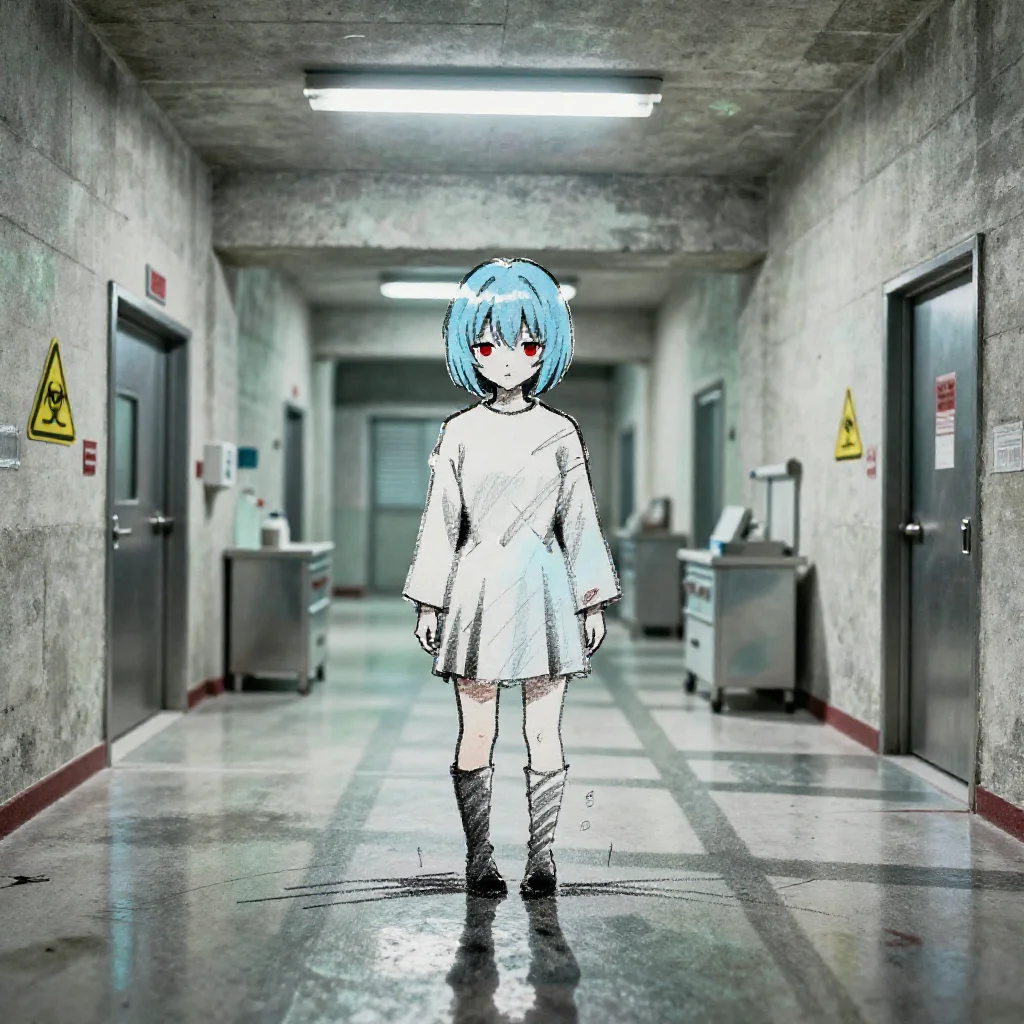
    A mixed-media scene combining realistic photography and hand-drawn illustration. Rei Ayanami with her distinctive pale blue hair cut in a short bob and crimson red eyes staring with unsettling emptiness, standing motionless in her white school uniform, broken ink strokes, positioned in the center of a real-world brutalist concrete corridor of a research facility with harsh fluorescent lighting and clinical sterility. The character is not enclosed by a complete outline — the silhouette is fragmented, incomplete, and interrupted, with strokes that do not fully connect. A chibi-style, close up, her face completely expressionless with that characteristic blank stare, hands held loosely at her sides with fingers slightly curled, head perfectly level with an inhuman stillness, not a single muscle suggesting emotion or intention pose is dynamic, body standing in perfect vertical alignment with unnatural posture rigidity, arms hanging straight down, feet together at attention, yet somehow the fragmented sketch lines suggest she might dissolve or reassemble at any moment, the white uniform bleeding into the surrounding space, her presence simultaneously solid and ephemeral like a ghost haunting the facility that created her. In the background, a blurred real-world brutalist institutional hallway — exposed concrete walls with visible formwork patterns, harsh overhead fluorescent tubes creating stark pools of light, stainless steel doors with biohazard warnings, reflective linoleum floors, medical equipment visible through doorways, emergency exit signs glowing red — color palette dominated by cold sterile whites, institutional grays, washed-out greens from fluorescent lights, with shocking accents of blood red from her eyes and warning signs, extreme chromatic aberration around the fluorescent tubes creating sickly green and magenta color fringing, intentional color channel offset creating a disorienting RGB separation around high-contrast edges suggesting digital corruption or reality breakdown, minimal anamorphic lens distortion but with clinical wide-angle perspective distortion making the hallway feel infinite, moderate film grain mixed with digital noise creating an unsettling hybrid analog-digital texture, severe color shift between zones creating patches of cold blue-white transitioning to sickly yellow-green, the lighting quality reminiscent of Andrei Tarkovsky's Stalker with its unsettling institutional spaces, intentional crushing of mid-tones creating poster-like separation between light and shadow zones. There is no solid interior at all. The body is formed by scattered and chaotic circular sketch lines, short and long hatching marks, and scribbles, leaving large open gaps where the real background passes through uninterrupted. The character feels barely held together, as if it exists only as an idea drawn in the air. The strokes vary in pressure and density: some lines are darker around her eyes and hair, others barely visible suggesting her tenuous connection to physical existence. Edges dissolve into fewer marks instead of closing into a contour. The surrounding environment is fully realistic photography: with a soft, blurred background and shallow depth of field. The character shadow, cast in multiple harsh directions from the overhead fluorescent banks with clinical precision, has volume, and does interact a physical object. her shadow falls across the reflective floor creating a perfect mirror beneath her feet, stretches up the concrete wall behind her bending over the rough texture, interacts with a medical cart casting complex overlapping geometric shadows, the multiple light sources creating a cross-pattern of shadows that somehow emphasizes her isolation. Camera angle: perfectly centered eye-level shot with symmetrical composition, positioned at the end of the hallway creating one-point perspective, medium-full shot capturing her complete figure in the architectural void. Mood: existential emptiness, clinical depression manifested visually, the uncanny valley between human and construct, profound loneliness in institutional spaces, apocalyptic stillness, color grading inspired by Stanley Kubrick's sterile symmetry and David Lynch's industrial unease, questioning the nature of soul and consciousness, beautiful desolation, waiting for an ending or a beginning that may never come.
    Prompt

    A mixed-media scene combining realistic photography and hand-drawn illustration. Rei Ayanami with her distinctive pale blue hair cut in a short bob and crimson red eyes staring with unsettling emptiness, standing motionless in her white school uniform, broken ink strokes, positioned in the center of a real-world brutalist concrete corridor of a research facility with harsh fluorescent lighting and clinical sterility. The character is not enclosed by a complete outline — the silhouette is fragmented, incomplete, and interrupted, with strokes that do not fully connect. A chibi-style, close up, her face completely expressionless with that characteristic blank stare, hands held loosely at her sides with fingers slightly curled, head perfectly level with an inhuman stillness, not a single muscle suggesting emotion or intention pose is dynamic, body standing in perfect vertical alignment with unnatural posture rigidity, arms hanging straight down, feet together at attention, yet somehow the fragmented sketch lines suggest she might dissolve or reassemble at any moment, the white uniform bleeding into the surrounding space, her presence simultaneously solid and ephemeral like a ghost haunting the facility that created her. In the background, a blurred real-world brutalist institutional hallway — exposed concrete walls with visible formwork patterns, harsh overhead fluorescent tubes creating stark pools of light, stainless steel doors with biohazard warnings, reflective linoleum floors, medical equipment visible through doorways, emergency exit signs glowing red — color palette dominated by cold sterile whites, institutional grays, washed-out greens from fluorescent lights, with shocking accents of blood red from her eyes and warning signs, extreme chromatic aberration around the fluorescent tubes creating sickly green and magenta color fringing, intentional color channel offset creating a disorienting RGB separation around high-contrast edges suggesting digital corruption or reality breakdown, minimal anamorphic lens distortion but with clinical wide-angle perspective distortion making the hallway feel infinite, moderate film grain mixed with digital noise creating an unsettling hybrid analog-digital texture, severe color shift between zones creating patches of cold blue-white transitioning to sickly yellow-green, the lighting quality reminiscent of Andrei Tarkovsky's Stalker with its unsettling institutional spaces, intentional crushing of mid-tones creating poster-like separation between light and shadow zones. There is no solid interior at all. The body is formed by scattered and chaotic circular sketch lines, short and long hatching marks, and scribbles, leaving large open gaps where the real background passes through uninterrupted. The character feels barely held together, as if it exists only as an idea drawn in the air. The strokes vary in pressure and density: some lines are darker around her eyes and hair, others barely visible suggesting her tenuous connection to physical existence. Edges dissolve into fewer marks instead of closing into a contour. The surrounding environment is fully realistic photography: with a soft, blurred background and shallow depth of field. The character shadow, cast in multiple harsh directions from the overhead fluorescent banks with clinical precision, has volume, and does interact a physical object. her shadow falls across the reflective floor creating a perfect mirror beneath her feet, stretches up the concrete wall behind her bending over the rough texture, interacts with a medical cart casting complex overlapping geometric shadows, the multiple light sources creating a cross-pattern of shadows that somehow emphasizes her isolation. Camera angle: perfectly centered eye-level shot with symmetrical composition, positioned at the end of the hallway creating one-point perspective, medium-full shot capturing her complete figure in the architectural void. Mood: existential emptiness, clinical depression manifested visually, the uncanny valley between human and construct, profound loneliness in institutional spaces, apocalyptic stillness, color grading inspired by Stanley Kubrick's sterile symmetry and David Lynch's industrial unease, questioning the nature of soul and consciousness, beautiful desolation, waiting for an ending or a beginning that may never come.

    Generation Settings

    Parameters used to generate this content

    Created with
    ComfyUI
    CFG Scale1
    Sampler
    Euler
    Seed468577508174228
    Steps8
    Negative Prompt

    sfw blurry ugly bad

    ComfyUI Workflow

    The node graph used to generate this content — pan and zoom to explore, or download it to run in ComfyUI.

    Info
    Image
    Likes
    0
    Created
    1/25/2026
    Source
    CivitAI
    Models Used

    AI models used to generate this content

    Actions