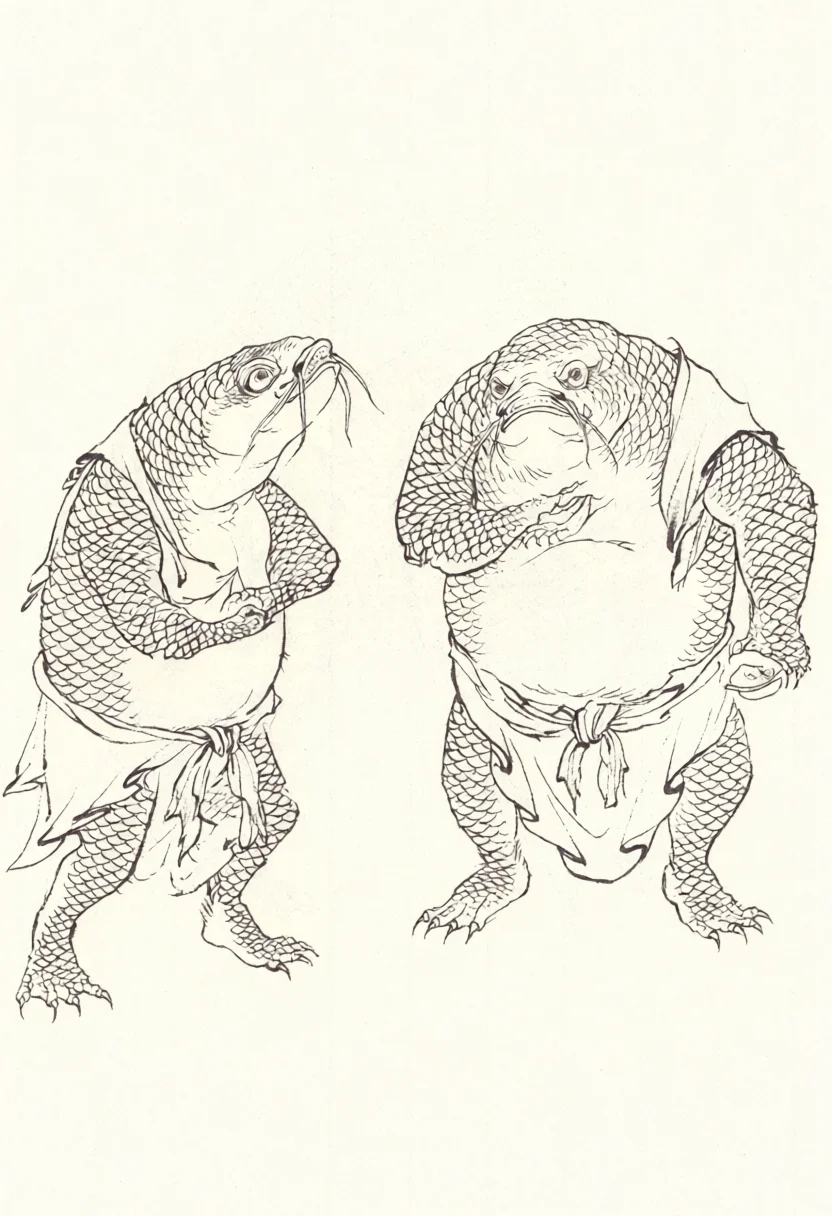
The image depicts two anthropomorphic fish-like creatures drawn in a detailed black-and-white line art style, reminiscent of traditional East Asian ink illustrations. Both figures possess stout, rounded bodies covered entirely in overlapping scales that extend from their heads down to their legs and feet. Their faces resemble those of large carp or catfish, with prominent eyes, wide mouths, and long whiskers extending downward from the sides of their snouts. They stand upright on two legs ending in clawed feet resembling webbed paws. Each creature wears a simple loincloth tied around its waist; one has additional fabric draped over its shoulders like a scarf or shawl. The figure on the left appears slightly smaller and leans forward with hands clasped together near its chest as if in conversation or pleading, while the larger figure on the right stands more squarely, holding what seems to be a small object—perhaps food or an offering—in one hand. Between them is a faint outline suggesting interaction or exchange. These beings are not directly identifiable characters from *Journey to the West* but strongly evoke the mythological aquatic spirits (such as river gods, water demons, or transformed fish monsters) commonly found within Chinese folklore associated with the text’s universe. In this context, such creatures might represent minor supernatural entities inhabiting rivers or lakes along the pilgrimage route, sometimes appearing as obstacles or aids depending on their alignment. While no specific named character from the original novel matches these exact forms, they align stylistically and conceptually with the rich pantheon of animal-spirits and shape-shifters encountered by Sun Wukong and his companions during their journey westward.
Parameters used to generate this content
The node graph used to generate this content — pan and zoom to explore, or download it to run in ComfyUI.
AI models used to generate this content