Vintage_Jazz-Club(V1)

    Showing 17 posts created with this model
    🖼️
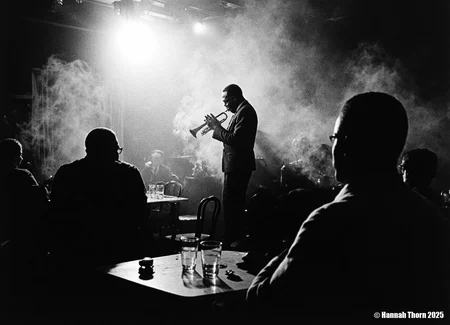
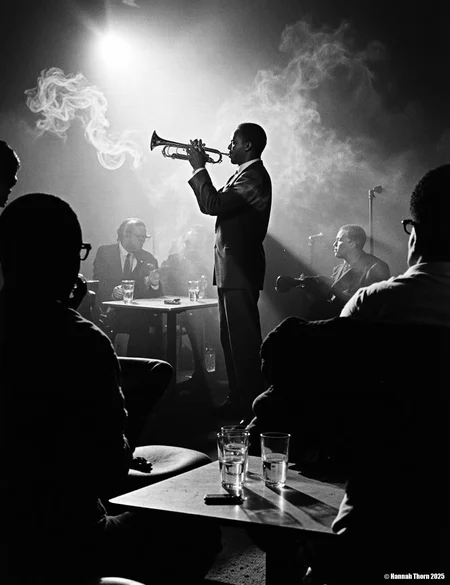
    The image is a black and white photograph of Miles Davis playing his trumpet.  The photo is taken in a dimly lit, smoky environment, possibly a jazz club. Davis is centrally positioned, but slightly off-center, his body angled towards the trumpet. He's captured mid-performance, his face partially obscured by shadows and the smoke, creating a dramatic and mysterious atmosphere.  He's wearing a dark suit. His focus is entirely on his instrument.  In the foreground, the backs of other patrons are visible, partially silhouetted, seated at a table with glasses, suggesting the scene is from a live performance.  The smoke adds depth and texture to the photo, and the lighting creates strong contrast, with bright spots highlighting Davis and his trumpet, and leaving the rest in shadows.  The overall feeling is intimate and moody. The photograph's style is strongly reminiscent of classic jazz photography. It uses elements of: Chiaroscuro: The dramatic use of light and shadow to create strong contrasts and a sense of depth. High Contrast: The deep blacks and bright whites add to the intensity and emotion of the scene. Documentary style: It seemingly captures a candid moment from a real-life event, without significant staging.  While composed, the image feels unplanned, spontaneous, and captures the essence of the moment. Grainy texture: The texture of the photo suggests a potential film grain, further adding to its vintage aesthetic and enhancing the atmosphere. Silhouettes: The use of silhouettes for the audience members in the foreground adds to the intimacy and focuses attention on Davis. The overall aesthetic is evocative and atmospheric, capturing the mood and ambiance of a jazz club during a performance.  The style is both artistic and journalistic, conveying both the emotional energy of the performance and a sense of reality.<lora:_Flux\Vintage_Jazz-Club.safetensors:1.0:1.0>
    Flux.1 D

    The image is a black and white photograph of Miles Davis playing his trumpet.  The photo is taken in a dimly lit, smoky environment, possibly a jazz club. Davis is centrally positioned, but slightly off-center, his body angled towards the trumpet. He's captured mid-performance, his face partially obscured by shadows and the smoke, creating a dramatic and mysterious atmosphere. He's wearing a dark suit. His focus is entirely on his instrument. In the foreground, the backs of other patrons are visible, partially silhouetted, seated at a table with glasses, suggesting the scene is from a live performance. The smoke adds depth and texture to the photo, and the lighting creates strong contrast, with bright spots highlighting Davis and his trumpet, and leaving the rest in shadows. The overall feeling is intimate and moody. The photograph's style is strongly reminiscent of classic jazz photography. It uses elements of: Chiaroscuro: The dramatic use of light and shadow to create strong contrasts and a sense of depth. High Contrast: The deep blacks and bright whites add to the intensity and emotion of the scene. Documentary style: It seemingly captures a candid moment from a real-life event, without significant staging. While composed, the image feels unplanned, spontaneous, and captures the essence of the moment. Grainy texture: The texture of the photo suggests a potential film grain, further adding to its vintage aesthetic and enhancing the atmosphere. Silhouettes: The use of silhouettes for the audience members in the foreground adds to the intimacy and focuses attention on Davis. The overall aesthetic is evocative and atmospheric, capturing the mood and ambiance of a jazz club during a performance. The style is both artistic and journalistic, conveying both the emotional energy of the performance and a sense of reality.<lora:_Flux\Vintage_Jazz-Club.safetensors:1.0:1.0>

    6 likes
    🖼️
    The picture is a black and white photograph depicting a scene in a dimly lit jazz club.    The style is reminiscent of classic black and white photography, possibly inspired by the aesthetics of the mid-20th century, evoking a nostalgic feeling of old Hollywood or a smoky jazz club. The lighting is dramatic, with spotlights illuminating the stage and the band, while the patrons in the foreground are less brightly lit, creating a sense of depth and focus. The composition includes a band performing on stage with a saxophone player prominently featured, and a crowd of people seated at tables, observing the performance.    The overall atmosphere is one of quiet intensity and sophisticated ambiance. The grainy texture of the image further enhances the vintage aesthetic. The dark tones, contrasted by the bright stage lights, contribute to the mood of intimacy and mystery. The clothing styles of both the band members and the patrons are consistent with a time period in the mid 20th century, likely the 1940s or 1950s, strengthening the vintage aesthetic. The image is sharp enough to capture detail but maintains a slightly grainy texture that adds to the film-like, vintage quality. <lora:_Flux\Vintage_Jazz-Club.safetensors:1.0:1.0>
    Flux.1 D

    The picture is a black and white photograph depicting a scene in a dimly lit jazz club.  The style is reminiscent of classic black and white photography, possibly inspired by the aesthetics of the mid-20th century, evoking a nostalgic feeling of old Hollywood or a smoky jazz club. The lighting is dramatic, with spotlights illuminating the stage and the band, while the patrons in the foreground are less brightly lit, creating a sense of depth and focus. The composition includes a band performing on stage with a saxophone player prominently featured, and a crowd of people seated at tables, observing the performance.  The overall atmosphere is one of quiet intensity and sophisticated ambiance. The grainy texture of the image further enhances the vintage aesthetic. The dark tones, contrasted by the bright stage lights, contribute to the mood of intimacy and mystery. The clothing styles of both the band members and the patrons are consistent with a time period in the mid 20th century, likely the 1940s or 1950s, strengthening the vintage aesthetic. The image is sharp enough to capture detail but maintains a slightly grainy texture that adds to the film-like, vintage quality. <lora:_Flux\Vintage_Jazz-Club.safetensors:1.0:1.0>

    6 likes
    🖼️
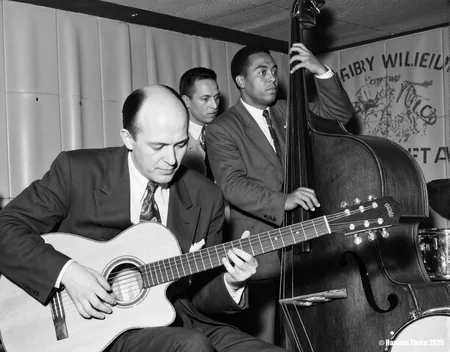
    The picture is a black and white photograph of a jazz ensemble in what appears to be a club or bar setting.    The image shows three musicians prominently featured.  In the foreground, a man with a bald head is seated, playing a classical guitar. He is wearing a dark suit and tie. To his right, a man plays an upright double bass; he is African American, wearing a suit and tie, and  is engrossed in playing his instrument. Behind the guitarist, partially obscured, is a third musician, a fair-skinned man with short hair, also in a suit and tie. He's likely a drummer, as a snare drum is visible behind him.  The background suggests a simple, somewhat dimly lit venue. There is visible wood paneling on the wall and a glimpse of a tiled ceiling. Part of a wall-mounted advertisement or artwork is visible in the upper right corner.  The style of the photograph is consistent with mid-20th-century photojournalism or documentary photography. The black and white palette, candid composition, and focus on the musicians in an informal setting, all contribute to this stylistic identification.  The image has a slightly grainy texture characteristic of older photographic processes. The lighting is somewhat subdued, likely typical of a dimly lit club at night, casting a certain moodiness onto the scene. The overall feel is one of realism and authenticity, capturing a moment in time. <lora:_Flux\Vintage_Jazz-Club.safetensors:1.0:1.0>
    Flux.1 D

    The picture is a black and white photograph of a jazz ensemble in what appears to be a club or bar setting.  The image shows three musicians prominently featured. In the foreground, a man with a bald head is seated, playing a classical guitar. He is wearing a dark suit and tie. To his right, a man plays an upright double bass; he is African American, wearing a suit and tie, and is engrossed in playing his instrument. Behind the guitarist, partially obscured, is a third musician, a fair-skinned man with short hair, also in a suit and tie. He's likely a drummer, as a snare drum is visible behind him. The background suggests a simple, somewhat dimly lit venue. There is visible wood paneling on the wall and a glimpse of a tiled ceiling. Part of a wall-mounted advertisement or artwork is visible in the upper right corner. The style of the photograph is consistent with mid-20th-century photojournalism or documentary photography. The black and white palette, candid composition, and focus on the musicians in an informal setting, all contribute to this stylistic identification. The image has a slightly grainy texture characteristic of older photographic processes. The lighting is somewhat subdued, likely typical of a dimly lit club at night, casting a certain moodiness onto the scene. The overall feel is one of realism and authenticity, capturing a moment in time. <lora:_Flux\Vintage_Jazz-Club.safetensors:1.0:1.0>

    6 likes
    🖼️
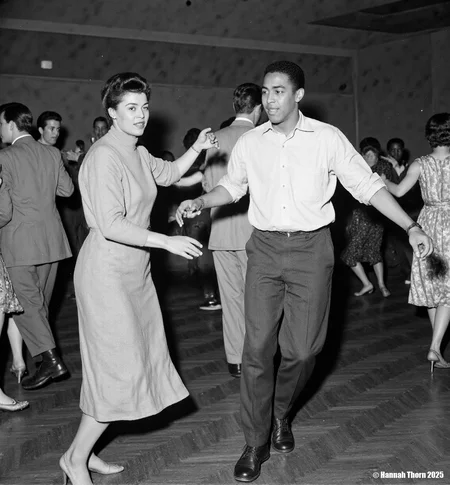
    The picture is a black and white photograph depicting a lively dance scene, likely at a social event or club in the mid-20th century.  The focus is on a young Afro-American couple dancing. The woman, wearing a simple, elegant sweater and a knee-length skirt, is moving with grace. Her partner is stylishly dressed in a light-colored shirt and dark trousers. He appears to be leading the dance.  In the background, other couples and people are visible, enjoying the music. A saxophone player is noticeable amidst the dancers, indicating a jazz or swing atmosphere. The background is blurred, drawing attention to the main dancing couple in the foreground. The overall style suggests candid photography, capturing the spontaneous energy of the moment. The photographic style is reminiscent of photojournalism or street photography from the mid-20th century. The use of black and white enhances the contrast and mood, creating a timeless quality. The slightly grainy texture and focus on capturing movement in a realistic manner further contributes to the authenticity of the scene. The shallow depth of field keeps the focus sharply on the central dancing couple while maintaining enough context through the slightly blurred background.  The composition, with the central couple framed in the dance floor, guides the viewer's attention effectively. <lora:_Flux\Vintage_Jazz-Club.safetensors:1.0:1.0>
    Flux.1 D

    The picture is a black and white photograph depicting a lively dance scene, likely at a social event or club in the mid-20th century.  The focus is on a young Afro-American couple dancing. The woman, wearing a simple, elegant sweater and a knee-length skirt, is moving with grace. Her partner is stylishly dressed in a light-colored shirt and dark trousers. He appears to be leading the dance.  In the background, other couples and people are visible, enjoying the music. A saxophone player is noticeable amidst the dancers, indicating a jazz or swing atmosphere. The background is blurred, drawing attention to the main dancing couple in the foreground. The overall style suggests candid photography, capturing the spontaneous energy of the moment. The photographic style is reminiscent of photojournalism or street photography from the mid-20th century. The use of black and white enhances the contrast and mood, creating a timeless quality. The slightly grainy texture and focus on capturing movement in a realistic manner further contributes to the authenticity of the scene. The shallow depth of field keeps the focus sharply on the central dancing couple while maintaining enough context through the slightly blurred background. The composition, with the central couple framed in the dance floor, guides the viewer's attention effectively. <lora:_Flux\Vintage_Jazz-Club.safetensors:1.0:1.0>

    6 likes
    🖼️
    The image is a black and white photograph of Miles Davis playing his trumpet.    **Description:**  The photo is taken in a dimly lit, smoky environment, possibly a jazz club. Davis is centrally positioned, but slightly off-center, his body angled towards the trumpet. He's captured mid-performance, his face partially obscured by shadows and the smoke, creating a dramatic and mysterious atmosphere.  He's wearing a dark suit. His focus is entirely on his instrument.  In the foreground, the backs of other patrons are visible, partially silhouetted, seated at a table with glasses, suggesting the scene is from a live performance.  The smoke adds depth and texture to the photo, and the lighting creates strong contrast, with bright spots highlighting Davis and his trumpet, and leaving the rest in shadows.  The overall feeling is intimate and moody.  **Style:**  The photograph's style is strongly reminiscent of classic jazz photography. It uses elements of:  * **Chiaroscuro:** The dramatic use of light and shadow to create strong contrasts and a sense of depth. * **High Contrast:** The deep blacks and bright whites add to the intensity and emotion of the scene. * **Documentary style:** It seemingly captures a candid moment from a real-life event, without significant staging.  While composed, the image feels unplanned, spontaneous, and captures the essence of the moment. * **Grainy texture:** The texture of the photo suggests a potential film grain, further adding to its vintage aesthetic and enhancing the atmosphere. * **Silhouettes:** The use of silhouettes for the audience members in the foreground adds to the intimacy and focuses attention on Davis.  The overall aesthetic is evocative and atmospheric, capturing the mood and ambiance of a jazz club during a performance.  The style is both artistic and journalistic, conveying both the emotional energy of the performance and a sense of reality. <lora:_Flux\Vintage_Jazz-Club.safetensors:1.0:1.0>
    Flux.1 D

    The image is a black and white photograph of Miles Davis playing his trumpet.  **Description:** The photo is taken in a dimly lit, smoky environment, possibly a jazz club. Davis is centrally positioned, but slightly off-center, his body angled towards the trumpet. He's captured mid-performance, his face partially obscured by shadows and the smoke, creating a dramatic and mysterious atmosphere. He's wearing a dark suit. His focus is entirely on his instrument. In the foreground, the backs of other patrons are visible, partially silhouetted, seated at a table with glasses, suggesting the scene is from a live performance. The smoke adds depth and texture to the photo, and the lighting creates strong contrast, with bright spots highlighting Davis and his trumpet, and leaving the rest in shadows. The overall feeling is intimate and moody. **Style:** The photograph's style is strongly reminiscent of classic jazz photography. It uses elements of: * **Chiaroscuro:** The dramatic use of light and shadow to create strong contrasts and a sense of depth. * **High Contrast:** The deep blacks and bright whites add to the intensity and emotion of the scene. * **Documentary style:** It seemingly captures a candid moment from a real-life event, without significant staging. While composed, the image feels unplanned, spontaneous, and captures the essence of the moment. * **Grainy texture:** The texture of the photo suggests a potential film grain, further adding to its vintage aesthetic and enhancing the atmosphere. * **Silhouettes:** The use of silhouettes for the audience members in the foreground adds to the intimacy and focuses attention on Davis. The overall aesthetic is evocative and atmospheric, capturing the mood and ambiance of a jazz club during a performance. The style is both artistic and journalistic, conveying both the emotional energy of the performance and a sense of reality. <lora:_Flux\Vintage_Jazz-Club.safetensors:1.0:1.0>

    5 likes
    🖼️
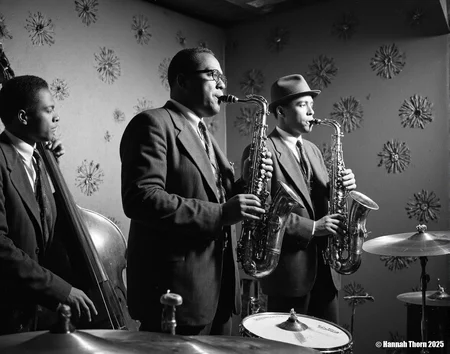
    The image is a black and white photograph depicting a jazz band in performance.    **Description:**  The photo shows three musicians prominently featured. The central figure is a man playing a tenor saxophone; he's wearing a dark suit and tie. To his right, another man in a suit and fedora plays an alto saxophone. On the left, partially obscured, a third musician is visible, playing a double bass. The background is a dimly lit room with indistinct wall décor that suggests a jazz club setting.  There are drums partially visible in the foreground, along with cymbals. The lighting is dramatic, focusing primarily on the saxophonists, with the rest of the scene falling into shadow. The overall mood is one of intense concentration and musical energy.   **Style:**  The photograph's style is classic black and white photojournalism or fine art photography, characteristic of mid-20th-century jazz photography.  The use of high contrast, deep shadows, and a focus on the musicians' expressive faces and hands creates a sense of intimacy and immediacy. The grainy texture of the image, which is probably intentional, adds to the vintage feel and emphasizes the mood of the scene. The composition is relatively candid, with the musicians seemingly caught in the moment of performance rather than posed formally.  The use of light and shadow helps draw the viewer's eye to the central musicians and instruments. <lora:_Flux\Vintage_Jazz-Club.safetensors:1.0:1.0>
    Flux.1 D

    The image is a black and white photograph depicting a jazz band in performance.  **Description:** The photo shows three musicians prominently featured. The central figure is a man playing a tenor saxophone; he's wearing a dark suit and tie. To his right, another man in a suit and fedora plays an alto saxophone. On the left, partially obscured, a third musician is visible, playing a double bass. The background is a dimly lit room with indistinct wall décor that suggests a jazz club setting. There are drums partially visible in the foreground, along with cymbals. The lighting is dramatic, focusing primarily on the saxophonists, with the rest of the scene falling into shadow. The overall mood is one of intense concentration and musical energy. **Style:** The photograph's style is classic black and white photojournalism or fine art photography, characteristic of mid-20th-century jazz photography. The use of high contrast, deep shadows, and a focus on the musicians' expressive faces and hands creates a sense of intimacy and immediacy. The grainy texture of the image, which is probably intentional, adds to the vintage feel and emphasizes the mood of the scene. The composition is relatively candid, with the musicians seemingly caught in the moment of performance rather than posed formally. The use of light and shadow helps draw the viewer's eye to the central musicians and instruments. <lora:_Flux\Vintage_Jazz-Club.safetensors:1.0:1.0>

    5 likes
    🖼️
    The image is a black and white close-up shot of a saxophonist playing a tenor saxophone.  The focus is sharply on the saxophone and the musician's hands, which are positioned on the instrument's keys and valves.  The saxophone itself appears aged, with a slightly worn look to its metallic surface. The details of the instrument, such as its keys and bell, are clearly visible.  The saxophonist is wearing a somewhat loose-fitting jacket and a visible portion of a collared shirt underneath. The background is significantly out of focus, but shows a blurry figure, seemingly another musician playing an upright bass, suggesting a jazz or blues performance setting.  The background lighting is dim, with some blurred light sources visible, contributing to the moody atmosphere.  The style of the photograph is distinctly **black and white photojournalism** or **concert photography**.  The high contrast, shallow depth of field (emphasizing the saxophone while blurring the background), and the candid feel (as if capturing a moment during a live performance) are all typical of these styles. The monochrome palette enhances the dramatic effect and focuses attention on the texture and form of the saxophone and the musician’s interaction with it. The overall mood is intimate and intense, conveying the emotion and energy of a live music performance. <lora:_Flux\Vintage_Jazz-Club.safetensors:1.0:1.0>
    Flux.1 D

    The image is a black and white close-up shot of a saxophonist playing a tenor saxophone. The focus is sharply on the saxophone and the musician's hands, which are positioned on the instrument's keys and valves. The saxophone itself appears aged, with a slightly worn look to its metallic surface. The details of the instrument, such as its keys and bell, are clearly visible. The saxophonist is wearing a somewhat loose-fitting jacket and a visible portion of a collared shirt underneath. The background is significantly out of focus, but shows a blurry figure, seemingly another musician playing an upright bass, suggesting a jazz or blues performance setting. The background lighting is dim, with some blurred light sources visible, contributing to the moody atmosphere. The style of the photograph is distinctly **black and white photojournalism** or **concert photography**. The high contrast, shallow depth of field (emphasizing the saxophone while blurring the background), and the candid feel (as if capturing a moment during a live performance) are all typical of these styles. The monochrome palette enhances the dramatic effect and focuses attention on the texture and form of the saxophone and the musician’s interaction with it. The overall mood is intimate and intense, conveying the emotion and energy of a live music performance. <lora:_Flux\Vintage_Jazz-Club.safetensors:1.0:1.0>

    4 likes
    🖼️
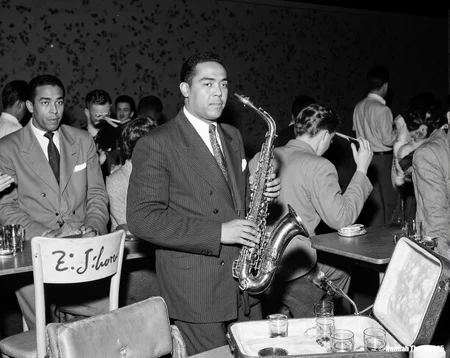
    The image is a black and white photograph of the renowned jazz saxophonist, Lester Young, seemingly at a club or bar.    **Description:**  Lester Young is centrally positioned, holding a saxophone. He's dressed in a dark suit and tie, projecting a sophisticated yet relaxed demeanor. The saxophone is partially nestled in its case, which is open and rests on a table. The table is also occupied by what appears to be small glasses or cups and an ashtray.   Behind and to the side of Young are several people, some appear to be patrons of the establishment. One woman is visible, smoking a cigarette; others are partially obscured.  A sign that reads "E.E. Charles" is on the back of a chair behind the table.  The background shows a dark, possibly dimly lit interior with some indistinct wall markings or decorations.  The overall atmosphere appears to be that of a lively yet intimate setting.   **Style:**  The style of the photograph is classic black and white photojournalism or candid portraiture.  The contrast is strong, typical of the era, likely produced from film negatives. The grain is visible, adding to its documentary feel. The composition is fairly straightforward, drawing the viewer's attention immediately to Lester Young. The candid nature of the shot, with other patrons present, makes it seem like a spontaneous capture of a moment rather than a formally posed portrait. The grainy texture and the high contrast between light and shadow are characteristic of mid-20th-century street photography and jazz photography styles.  The slightly blurred background also helps to focus the viewer's eye on Lester Young and his saxophone. <lora:_Flux\Vintage_Jazz-Club.safetensors:1.0:1.0>
    Flux.1 D

    The image is a black and white photograph of the renowned jazz saxophonist, Lester Young, seemingly at a club or bar.  **Description:** Lester Young is centrally positioned, holding a saxophone. He's dressed in a dark suit and tie, projecting a sophisticated yet relaxed demeanor. The saxophone is partially nestled in its case, which is open and rests on a table. The table is also occupied by what appears to be small glasses or cups and an ashtray.  Behind and to the side of Young are several people, some appear to be patrons of the establishment. One woman is visible, smoking a cigarette; others are partially obscured. A sign that reads "E.E. Charles" is on the back of a chair behind the table. The background shows a dark, possibly dimly lit interior with some indistinct wall markings or decorations. The overall atmosphere appears to be that of a lively yet intimate setting. **Style:** The style of the photograph is classic black and white photojournalism or candid portraiture. The contrast is strong, typical of the era, likely produced from film negatives. The grain is visible, adding to its documentary feel. The composition is fairly straightforward, drawing the viewer's attention immediately to Lester Young. The candid nature of the shot, with other patrons present, makes it seem like a spontaneous capture of a moment rather than a formally posed portrait. The grainy texture and the high contrast between light and shadow are characteristic of mid-20th-century street photography and jazz photography styles. The slightly blurred background also helps to focus the viewer's eye on Lester Young and his saxophone. <lora:_Flux\Vintage_Jazz-Club.safetensors:1.0:1.0>

    4 likes
    🖼️
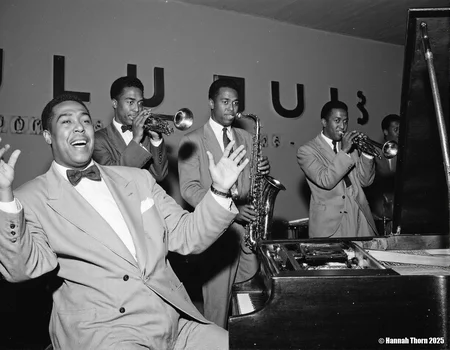
    The picture is a black and white photograph of a jazz band performing on a stage.  The image is sharply focused, capturing the energy and emotion of the musicians.  The style is reminiscent of classic mid-20th century jazz photography, likely taken sometime between the 1940s and 1960s.  The band is composed of at least five musicians:  * A pianist is prominently featured in the foreground, seated at a grand piano, his mouth open in joyous expression, his hands raised as if in the midst of a lively performance. He's wearing a formal jacket with a bow tie.  * To the left, a trumpeter stands, playing his instrument with concentration.  * To the right of the pianist, a saxophonist plays a tenor saxophone. He's dressed in a suit and bow tie, maintaining a focused expression.  * Slightly behind and to the right of the saxophonist, a trombonist is playing.  * At the far right, a double bassist is seen playing his instrument, contributing to the rich texture of the music.  Above the band, a sign reading "CLUB OASIS" is visible, indicating the venue where the photograph was taken.  The background is dimly lit, drawing focus to the musicians. The lighting is characteristic of performance photography of that era, creating subtle shadows and highlights that enhance the mood and texture of the scene.  The overall style is candid yet formal, capturing both the excitement of a live performance and the refined elegance of the musicians' attire. The monochrome palette adds a timeless quality, contributing to the image's nostalgic feel. The slightly grainy texture is also consistent with the photographic techniques of the time. <lora:_Flux\Vintage_Jazz-Club.safetensors:1.0:1.0>
    Flux.1 D

    The picture is a black and white photograph of a jazz band performing on a stage. The image is sharply focused, capturing the energy and emotion of the musicians. The style is reminiscent of classic mid-20th century jazz photography, likely taken sometime between the 1940s and 1960s. The band is composed of at least five musicians: * A pianist is prominently featured in the foreground, seated at a grand piano, his mouth open in joyous expression, his hands raised as if in the midst of a lively performance. He's wearing a formal jacket with a bow tie. * To the left, a trumpeter stands, playing his instrument with concentration. * To the right of the pianist, a saxophonist plays a tenor saxophone. He's dressed in a suit and bow tie, maintaining a focused expression. * Slightly behind and to the right of the saxophonist, a trombonist is playing. * At the far right, a double bassist is seen playing his instrument, contributing to the rich texture of the music. Above the band, a sign reading "CLUB OASIS" is visible, indicating the venue where the photograph was taken. The background is dimly lit, drawing focus to the musicians. The lighting is characteristic of performance photography of that era, creating subtle shadows and highlights that enhance the mood and texture of the scene. The overall style is candid yet formal, capturing both the excitement of a live performance and the refined elegance of the musicians' attire. The monochrome palette adds a timeless quality, contributing to the image's nostalgic feel. The slightly grainy texture is also consistent with the photographic techniques of the time. <lora:_Flux\Vintage_Jazz-Club.safetensors:1.0:1.0>

    4 likes
    🖼️
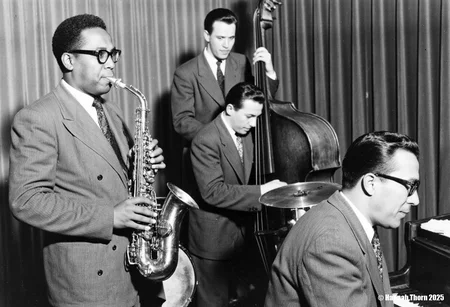
    The picture is a black and white photograph of the David Brubeck jazz quartet performing.  The style is reminiscent of mid-20th-century jazz photography, likely taken sometime between the 1950s and 1960s. The monochrome palette, the slightly grainy texture, and the focus on the musicians in a seemingly informal performance setting all contribute to this classic jazz aesthetic. The image has a candid feel, not posed or overly staged, suggesting it may be a captured moment from a live performance or rehearsal. The clothing of the musicians (suits and ties) also supports the era's style. The photograph shows four musicians: * A saxophonist (likely alto saxophone) in the foreground on the left, prominently featured and playing his instrument.  He wears glasses and a suit.  * A pianist, also in the foreground to the right, is seated at a piano and appears to be playing. He also wears glasses and a suit.  * A double bassist stands behind the pianist, playing his instrument.  * A drummer is partially visible behind the pianist, seated at his drum kit.  Only the top of his head and shoulders are seen.   The background is somewhat blurry, but shows a curtain or drapery, common in performance venues. The overall composition focuses on the musicians and their instruments, making it a strong visual representation of a jazz performance.  The lighting is primarily focused on the musicians, creating a dramatic effect and drawing attention to their expressions and the music-making. <lora:_Flux\Vintage_Jazz-Club.safetensors:1.0:1.0>
    Flux.1 D

    The picture is a black and white photograph of the David Brubeck jazz quartet performing.  The style is reminiscent of mid-20th-century jazz photography, likely taken sometime between the 1950s and 1960s. The monochrome palette, the slightly grainy texture, and the focus on the musicians in a seemingly informal performance setting all contribute to this classic jazz aesthetic. The image has a candid feel, not posed or overly staged, suggesting it may be a captured moment from a live performance or rehearsal. The clothing of the musicians (suits and ties) also supports the era's style. The photograph shows four musicians: * A saxophonist (likely alto saxophone) in the foreground on the left, prominently featured and playing his instrument. He wears glasses and a suit. * A pianist, also in the foreground to the right, is seated at a piano and appears to be playing. He also wears glasses and a suit. * A double bassist stands behind the pianist, playing his instrument. * A drummer is partially visible behind the pianist, seated at his drum kit. Only the top of his head and shoulders are seen. The background is somewhat blurry, but shows a curtain or drapery, common in performance venues. The overall composition focuses on the musicians and their instruments, making it a strong visual representation of a jazz performance. The lighting is primarily focused on the musicians, creating a dramatic effect and drawing attention to their expressions and the music-making. <lora:_Flux\Vintage_Jazz-Club.safetensors:1.0:1.0>

    4 likes
    🖼️
    Flux.1 D
    2 likes
    🖼️
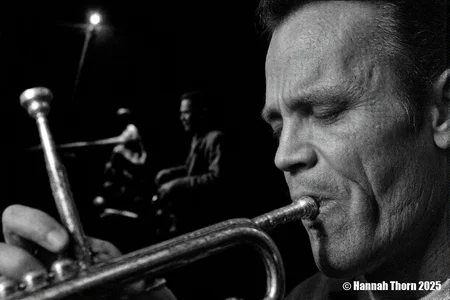
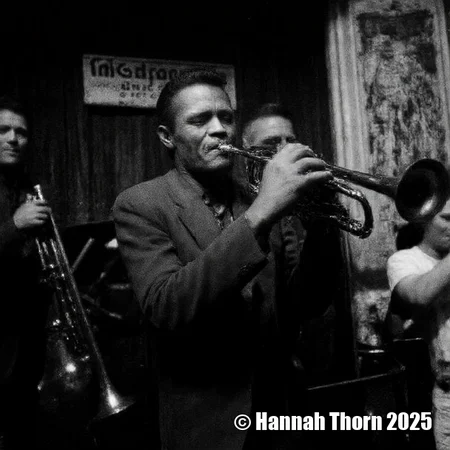
    A  captivating single black and white photograph, reminiscent of a Dorothea Lange portrait fused with a  gritty Henri Cartier-Bresson street scene, depicts a jazz band performance in  a dimly lit New Orleans club.  The central figure, a middle-aged Black man playing trombone with eyes closed, embodies the relaxed intensity of a Louis Armstrong  performance, bathed in chiaroscuro lighting à la Rembrandt.  To his right, a blurry, almost impressionistic bassist and a sharply focused trumpeter (a  close-up worthy of a Diane Arbus study, showcasing the strain of intense focus) complete the ensemble.  The background, suggesting depth through selective focus and atmospheric perspective, features "The Spotted Music Club" sign and street glimpses, creating  a nostalgic mood akin to a Walker Evans photograph.  The grainy texture mimics vintage silver gelatin prints, while the overall composition evokes a powerful narrative through light and shadow. <lora:_Flux\Vintage_Jazz-Club.safetensors:0.7000000000000001:0.7000000000000001> <lora:_Flux\_Characters\Chet_Baker_old.safetensors:1.0:1.0>
    Flux.1 D

    A captivating single black and white photograph, reminiscent of a Dorothea Lange portrait fused with a gritty Henri Cartier-Bresson street scene, depicts a jazz band performance in a dimly lit New Orleans club. The central figure, a middle-aged Black man playing trombone with eyes closed, embodies the relaxed intensity of a Louis Armstrong performance, bathed in chiaroscuro lighting à la Rembrandt. To his right, a blurry, almost impressionistic bassist and a sharply focused trumpeter (a close-up worthy of a Diane Arbus study, showcasing the strain of intense focus) complete the ensemble. The background, suggesting depth through selective focus and atmospheric perspective, features "The Spotted Music Club" sign and street glimpses, creating a nostalgic mood akin to a Walker Evans photograph. The grainy texture mimics vintage silver gelatin prints, while the overall composition evokes a powerful narrative through light and shadow. <lora:_Flux\Vintage_Jazz-Club.safetensors:0.7000000000000001:0.7000000000000001> <lora:_Flux\_Characters\Chet_Baker_old.safetensors:1.0:1.0>

    1 likes
    🖼️
    0 likes
    🖼️
    0 likes
    🖼️
    0 likes
    🖼️
    0 likes
    🖼️
    0 likes